|
| Tick before and after feeding |
Few things remind can remind you that you are part of the food chain in a more disturbing manner than the site of a tick crawling up your leg, or, worse yet- the site of one of those arachnids with its head already burrowed into your epidermis. External parasites are one thing, we have at least some control over our exposure to them but right now as you read the inside of your body is home to more organisms than you might care to know about. It is no surprise that public sentiment for parasites of all flavors does not run high. Indeed Nature magazine of all publications recently ran a news article suggesting that
if all the mosquitoes in the world went extinct global ecosystems would carry on with barely a hiccup. The article, more of an opinion piece than an actual scientific paper, was roundly criticized on several levels (read the comments). First off you would lose numerous freshwater fish species that depend on mosquito larvae, migratory birds that depend on arctic mosquitoes during the summer would be hard hit, and many flower species actually depend on mosquitoes as pollinators. The loss of more than 3000 mosquito species may in fact be more dire and catastrophic than one might imagine. The nature article does provide a service to our (mis)understanding of community ecology because it underscores a pervasive ecological bias towards parasites. Generally speaking the role of parasites in ecological studies has been historically downplayed, dismissed, or outright ignored. Why the bias? Well, most importantly imo, they are hated- we would rather imagine a world without them. Secondly they are generally small- how could such small, cryptic species be important? Thirdly their lifestyles are often complex and their effect on ecosystems may be equally complex and throw a monkey wrench into the conservative ecological dogma of herbivore eats plant predator eats herbivore blah blah.
So what are the ecological effects of parasites?
Well, you might want to read this
here but let's just look at some numbers.
If you were a biologist visiting earth you might be astonished at the simple numbers of parasitic species on this planet. Parasites, by some estimates, outnumber free living species 4 to 1. But this may be an underestimate, especially when you consider that parasites have parasites. Regardless parasitism is the dominant mode of life on this planet and that alien biologist would not be overstating the case by referring to earth as Planet Parasite.
By their simple numerical abundance we should expect parasites to have profound ecological implications.
And parasites are not simply freewheelin' along for the ride on lifes' movable buffet but recent studies suggest that they are often secret architects, planners, and commissionaires of their respective ecological communities.
Studies into the coastal marsh community highlight the profound effect of parasites on the organisms that live there.
Euhaplorchis californiensis navigates a lifecycle through three separate hosts- profoundly affecting the fortunes of each along the way. Life for these flukes begins in a pile of bird droppings.
These droppings are consumed by grazing horn snails. The fluke then effectively castrates the poor snails so that all of the snails resources go towards the fluke at which numerous free swimming flukes are produced. These "eunuch" snails, on a side note, now compete with reproductively capable members of their own species and actually cut snail populations in half.
These free swimming little buggas, once free from the snails, next target the gills of the California Killifish (Fundulus parvipinnis)- a common coastal species from Baja CA to the Bay area. The flukes then congregate around the brain of the fish. This results in some aberrant behavior on the part of the fish- who now flash and skimmer along the surface four times as much as uninfected fish. That parasite induced behavior results in the fish being 30X more likely to be nabbed by a fish eating bird than an uninfected fish. And now the parasite is in its final home- a bird- where it feeds and expels numerous eggs in the bird feces. One may imagine that these predatory birds would be more picky about eating potentially parasitized fish- but for them the benefits out weight the risks. Simply put, if all the fish were as difficult to catch as the healthy ones the fish eating birds could not exist in such abundance.
 |
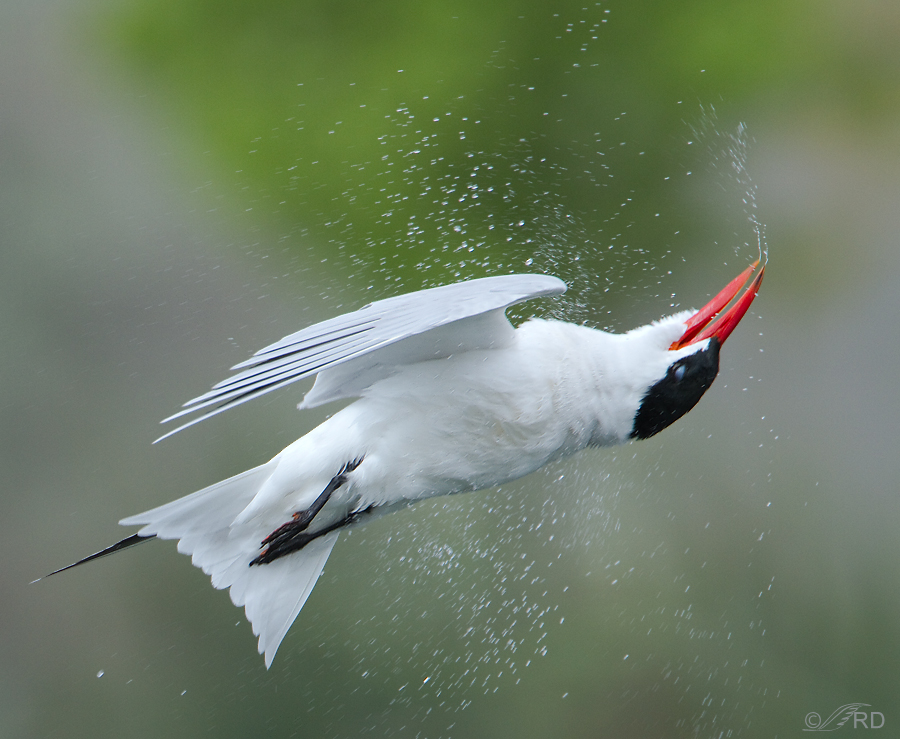
| Caspian Tern (c) Ron Dudley |
Yes we truly live in a parasite mediated world. Planet Parasite. Remember you can't call yourself a nature lover if you don't have some love for parasites. If you hate parasites you automatically hate the vast majority of life that lives and
has lived on this planet.
 |
| best parasite movie ever Brain Damage |
Coming Up Planet Parasite II: Battles in the North
Pertinencia
Nature Editorial: A World Without Mosquitoes
Ecological Consequences of Parasitism a Review
Lafferty, KD, RF Heckinger, JC Shaw, KL Whitney and AM Kuris. 2006. Food webs and parasites in a salt marsh ecosystem. In Disease Ecology: community structure and pathogen dynamics. Oxford Un Press.
pdf