Showing posts with label cycads. Show all posts

Saturday, December 27, 2014

Don't Draw Celibate Cycads!!

One does not have to look far to get into the well documented, especially on the paleoblogosphere, interplay between paleontology/paeoartistry/plagiarism/tropes etc. etc. Chances are if you read this blog you are aware of this crucial and ongoing debate especially as it pertains to certain tropes or memes that seem to get repeated, maybe even subconsciously, with regards to certain peculiarities or assumptions about the life appearance of extinct animals (esp dinos). And I don't really want to bother with a list of links to this ongoing discussion here although for starters there is the All Yesterdays movement, The Paleopolice FB/deviantart group, Support original Paleoart, and so on and so forth. What I want to do on this post is focus on the dilemma of "the celibate cycad".

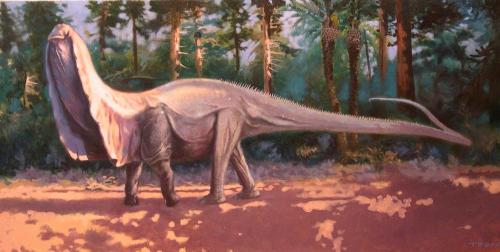
A bit of a qualifier here. Not that there is anything particularly wrong with depicting a cycad alone on the landscape or even utilizing what I refer to as "the big three" (ferns, cycads, conifers) in Mesozoic landscape - it is a question of representation and over utilization, especially when alternate views are more or just as defensible. In the past I made the same argument with dinosaurs always conveniently framed on a bare patch of dirt. Now, truth be told I can't take 100% credit for noting that very common trope - I recall first hearing it mentioned in an online discussion somewhere - but I do think it is worth noting and it is unabashedly common once you start looking for it. Again, not that there were no bare patches of ground in the Mesozoic and not that dinos did not stand on them - conveniently framing themselves - it is a question of this view being over represented. And, while it is true that this meme repeats so often as a function of the artist framing the main subject which is the animal, after a while this repetition becomes a disservice because it does not speak to the full mosaic of ways in which animals, even large ones, clamber through, hide in, and engage with the vegetation in their respective environments.
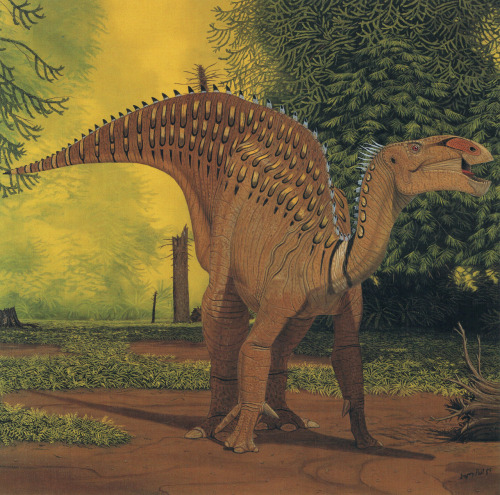
(c) Gregory S. Paul
(c) Conway
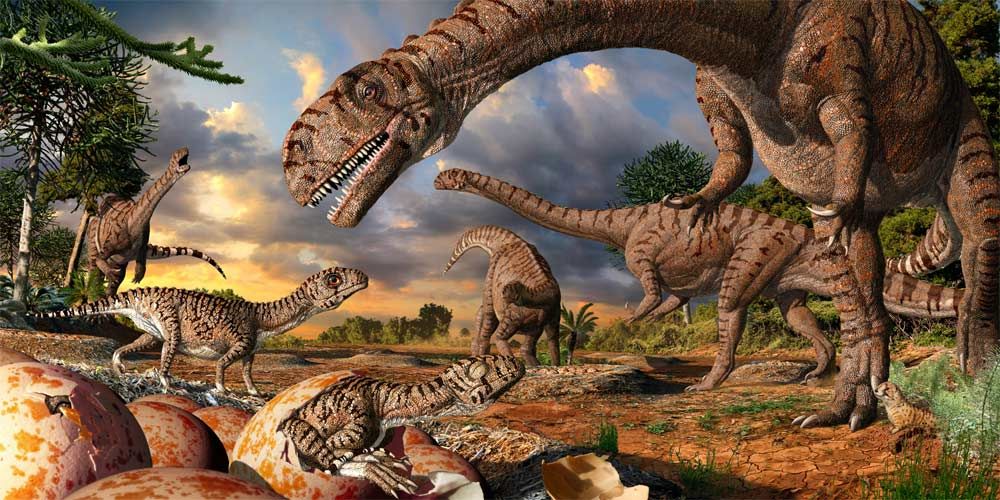
(c) Troco
All three above images, beautiful and illuminating in their own rights, all depict the dinosaur conveniently framed on a bare patch of soil meme.

And so onto the problem of "celibate cycads". I first heard the term "celibate cycad" in an article by Jennifer Frazer titled Are Cycads Social Plants? Now I have discussed this concept of large herbivore mediated cycad dispersal before here but to recap cycads are a bit of an enigma - slow growing, toxic foliage and large seeds with a fleshy, nutritious outer coating called a sarcosta but somewhat analogous to angiosperm "fruit". It has been surmised that the large seed serves two purposes - small dispersers such as monkeys, possums, rodents etc etc. will tend to move the seed not too far from the parent plant. This increases the chance of the seed growing up in the vicinity of other cycads and, because they are "sexed" plants with a male and female plant and pollinated by insects, enhances the chances of reproductive success. This explains why cycads do not invest in bountiful numbers of cheap, small seeds which would tend to be dispersed further from other cycads and thus grow up isolated and celibate. For large dispersers - flightless birds, giant marsupials, dinosaurs - many "fruits" can be swallowed whole and then deposited en masse in the animals dung and thus setting up the potential for a new grove. What is important to keep in mind is that whether it be via small or large animal mediated dispersal grove formation is encouraged in both scenarios. Further supporting this scenario is the tendency of cycads to mast reproduce concurrently to attract pollinators and dispersers in numbers.

2013. Hall & Walter. Macrozamia Miquellii. Mount Archer Park, Australia

And so this tendency to grow in groves and reproduce concurrently is an attribute that paleoartists should take note of when depicting Mesozoic landscapes. It is especially important if one makes the defensible speculation that dinosaur herbivores/omnivores were commonly attracted to these mast cycad fruiting events as a source of food. Or possibly pterosaurs, mammals, sphenodonts, and crocs as well.
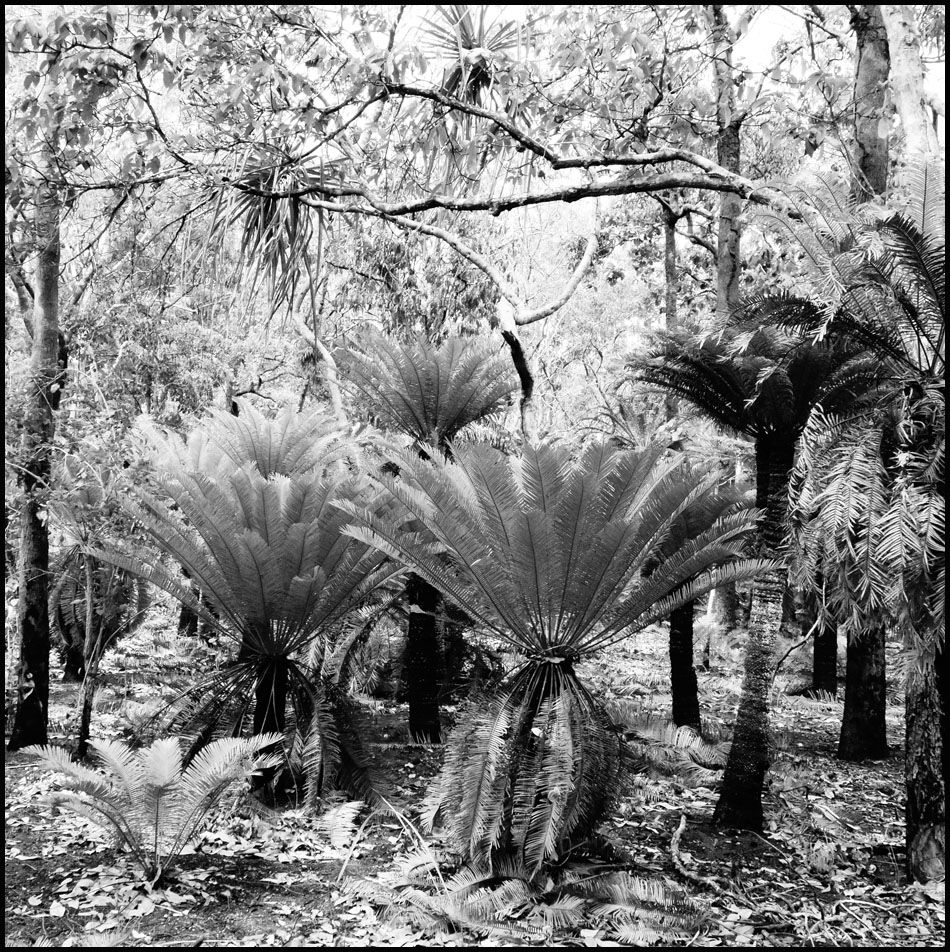
Arjay Bee
So are "celibate cycads" a problem in paleoart? I would say after looking over the vast majority of paleoart that no, most artists get cycads right with regards to depicting them most commonly in groves. But it is something to be aware of. I would love to see more of an emphasis on cycad groves as a common micro-habitat in Mesozoic landscapes.

However I would be remiss not to highlight the growth in popularity and utilization of digital artwork, especially per the influence of Julius Csotonyi, and possible problems there of. One of the main flaws in Julius' work as it pertains to vegetation is his plants are often vibrant green and look maintained as if in a park or garden - and this may have to do with the source photograph was from a park/garden. I have heard this criticism before but it bears repeating. Case in point here where the cycads are missing a skirt of old/dead dying leaves and some are borderline celibate. Also this one here which depicts several possible celibate cycads. And given their slow growth rates I don't place a lot of faith in cycads being common plants near riparian areas and dinosaur nesting grounds which are both prone to disturbance. And Julius also loves to put his dinos on a bare patch of dirt. Now I don't want to pick on Julius too much - I am not the hugest fan of digital art but Julius does a better job than most with it and I am a fan of his & his book -  but we should not be caught unawares that when certain artists get heralded as the "top of the line" that it is these exact artists that are the ones that most need to be looked at under a critical eye. This is due to the simple fact that these artists will have a proportionately greater influence than others over time. Whatever biases and flaws are imbued in their work, and history suggests that there are always some (see GSP and shrink-wrapping), will be co-opted by future artists. And this constant nit-picking of the top of the line artists will further refine the interplay of science and art in the future.
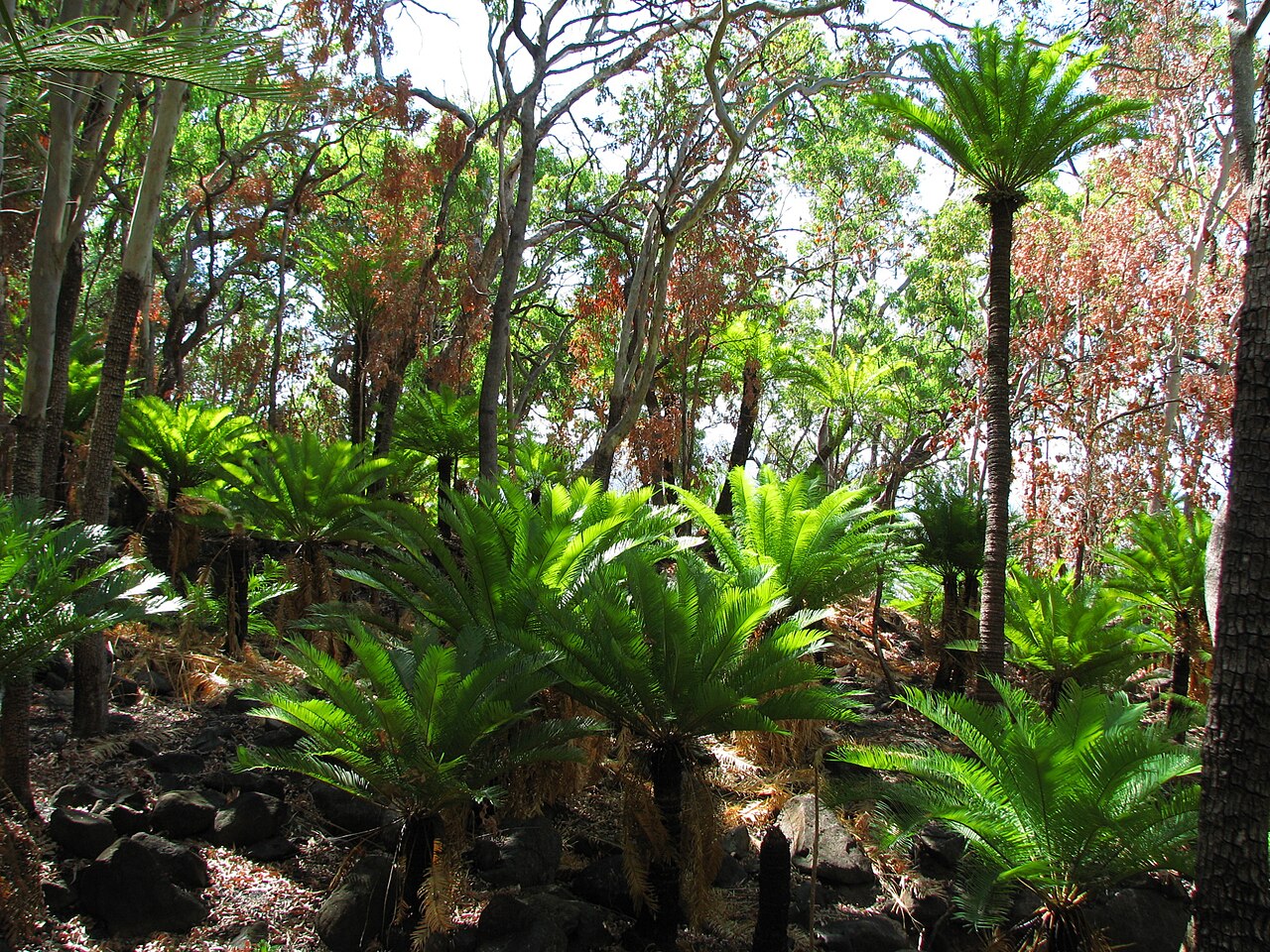
Cycas media. Tanetahi

Coming Soon: Don't worry loads more plesiosaur machinations coming up, if you liked the first two then lots more where they came from and IMO will get better and more interesting with time. Also if I don't post anything new before the New Year loads of more stuff planned for next year including some thought pieces and interpretations brand new!! Thanks for spending your time here consuming content when you could have spent it elsewhere in the unlimited free content world we live in. About to hit a quarter million unique page views!! Thanks


Support me on Patreon.
Like antediluvian salad on facebook.
Watch me on Deviantart @NashD1.Subscribe to my youtube channel Duane Nash.

Monday, March 18, 2013

Jurassic Burglar Alarm Final Edition

So I've been working on a picture for a couple of weeks now in color pencil. And since I've been staring at it so much while working on it I have grown kind of sick of it. Anyways there are some things I like about it, some things I am not so happy with....

"Jurassic Burglar Alarm" Duane Nash. 2013
Of course what grabs your attention is the saurian carnage- and that is no mistake- and if you want to read about why the fleeing toddler sauropod is mauled and why that Torvo is ripping some huevos out of the Allosaurus- read my post here. On the heels of the recent "All Yesterdays" backlash maybe I should preface everything with a "highly speculative" label.

Anyways I don't want to talk too much about the beasties depicted, although I should mention that I got inspiration for the Allo from the Perentie monitor of Australia, but what I do want to talk about is my
my choices for the vegetation. As I outlined in one of my earliest posts (Mesozoic Big Three) conifers, cycads, and ferns, although doubtless important during the Mesozoic, are over represented in depictions of Mesozoic vegetation in my opinion. Artists will often choice from a palette of pines, auracarians, generic cycads, tree ferns and run of the mill groundcover ferns. That being said I consciously went for vegetation of a slightly different bent. And although I do use conifers, cycads, and ferns in this pic I did try to portray them in slightly untypical styles. Also I tried to add color to the landscape. It is a common sentiment that the Mesozoic vegetation was colorless due to the lack of flowering plants and this attitude prevails in much of the art depicting this period. But if you look at the full panoply of plants which may have existed in these habits there is actually much option for color; the strange cones of cycads; weird hues in the wood of conifers; sporangia on ferns and horsetails; the weird pseudo-flowers of gnetales and seed ferns- perhaps even colorful enough to attract insect pollinators- you have a lot of color to choose from. And also keep in mind that even in angiosperm dominated landscapes you don't necessarily see a riot of color everywhere you look- think about savanna grasslands or tropical jungles- you mainly see hues of green, browns, and tans.

I picture the environment depicted here as part of the upper reaches of the Morrison formation-perhaps alluvial fans emanating form the Eastern mountains, Late Jurassic North America. It is a semi-arid area, but recent showers have greened up the landscape. In texture and mode it feels like chapparal, or scrubby savanna. The ground has a reddish, oxidized hue to it.

The knarly twisted juniper-looking conifers is a hypothetical cheirolepidiacean conifer and they dominate the landscape. The groundcover is a mix of putative types- I draw them in discrete bunches implying a type of slow motion war between the plants as they clamber for space, sun, and water.
The Baby Blue Bronto is in a patch of Ephedra like plants. Ephedra is a
type of gnetale and I invoke them here as a quite successful plant of arid conditions-as they are today. We do have good evidence for members
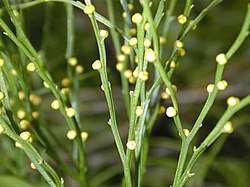
of the Gnetophyta in the early Cretaceous- perhaps there were ghost lineages going back further? The plants behind the Bronto and underneath the Torvo are putative whisk ferns. Whisk ferns, although allied with ferns, are another  botanical anomaly- we don't really know much about where they came from or their fossil record. They lack true roots but instead rely on mycorrhizal fungi. They spread with rhizoidal structures and lack true leaves but have chlorophyl in their stems. Today they are found widely scattered around the globe, suggesting perhaps a more widespread distribution in the past. The cycads in the foreground I depicted with their trunks underground, forming underground stems like a few extant cycads (Bowenia, Strangeria). I drew both male/female varieties and gave them some
Whisk Fern. Psilotum nudum
color as well. Maybe they released weird toxins into the soil to inhibit other plants. Little spreading ferns exist in the north side of the conifers and spread little runners during the wet season. The dense, mat forming vegetation under the Allosaur is a clump of putative lycopsids. Like the Resurrection plant they go dormant during the dry and spring to life rapidly with the returns of the rains. Here I depict them forming almost a grass like thatch of growth, spreading indefinitely via rhizomes, cropped back by hungry dinos.

You will also notice that I gave some hue & color to the soil itself. This is to imply a sort of biological soil crust, common today in arid regions, composed of a diverse community of moss, lichens, fungi, cyanobacteria that I suggest were common in appropriate environments during the Mesozoic. Perhaps even some dinos regularly nibbled these crusts?

Today soil crusts suffer from trampling and take many years, sometimes centuries to recover. Perhaps a community of crusts, ideally adapted to the large- but spreading- feet of many dinos existed forming a unique aspect to Mesozoic ecosystems?

And finally to the right you can see a large, amorphous, ctulhu looking clump of vegetation in my pic. That is another putative gnetophyte- this time based off the strange Welwitschia of the Namib desert.
This guy grows only two leaves- but they just keep growing- and have weird reproductive propagules.

Anyways what I hoped to do with this piece is get your attention with the dino carnage but really draw you in to the vegetation/environment as well. Just as there is a fossil bias for verteberates, there is a fossil bias for plants as well. There are just so many facets of the past we may never know. However I do not think we should get too conservative in construing possibilities just because the evidence is not ideal.

Cheers!!


Welwitschia mirabilis. Rob Nicholls (C)

Support me on Patreon.
Like antediluvian salad on facebook.
Watch me on Deviantart @NashD1.Subscribe to my youtube channel Duane Nash.


Sunday, November 11, 2012

Cycas debaoensis

(c) Chanin

Over at Jurassic Garden you can get a 1 inch seedling Cycas debaoensis for $150.00 or an 11.25" specimen for a little over $3, 500. That this rare and only recently discovered (late 90's) cycad found in isolated limestone cliffs in southern China is probably one of the most coveted cycads for cycadophiles is putting it mildly. But once you get a look at this plant it becomes immediately apparent that it does brake the mold of your typical cycad morph.

(c) Anders Lindstrom
                                                                                                                                                         
Most notable are the bipinnate leaves (two leaves), giving it a distinctly lush appearance. Contrast this with the more typically pinnate leaves of most cycads on the left. "Bamboo like" is a common description of this cycad and like bamboo this species is relatively fast growing, especially for a cycad. Interestingly this cycad has a subterranean caudex, meaning that the growing tip/main trunk is largely underground- so it lacks the typical "palm tree like" trunk of most cycads . Artists trying to depict Mesozoic cycads should not feel limited by the typical cycad shape and feel- a brief investigation into extant cycads reveals an unexpected diversity of form and habit. Doubtless an even greater diversity occurred during the Mesozoic.


Cheers!


Support me on Patreon.
Like antediluvian salad on facebook.
Watch me on Deviantart @NashD1.Subscribe to my youtube channel Duane Nash.


Related Posts Plugin for WordPress, Blogger...