Showing posts with label Spinosaurus aegyptiacus. Show all posts

Friday, September 19, 2014

Spinosaurus: The Tidal Rover (aka How I Interpret the Sail)

*My thoughts on how I think the sail was used keep changing and evolving. I am going to leave the post the way I originally wrote it but if you go to the '*' at the end you will see my view has changed a bit.

Qualifier: If you are not yet on board with an increasingly aquatic adaptation in Spinosaurus aegyptiacus are paths may have diverged a bit ago and this post may not be of use to you. If you take serious objection to my use of intuitive methods, deductive reasoning, storytelling, argument from analogy, and parsimonious route taking - chances are you might take objection here. I won't change my style and it's my blog anyways.

But if you are largely on board with the increasingly aquatic adaptations of Spinosaurus aegyptiacus; if you believe the best approach to eco-morphological reconstruction is a blend of both environmental context and anatomy; and if my interpretation of belly sliding as a probable terrestrial movement for Spinosaurus aegyptiacus intrigues you;  this post may be of some interest to you.

By the Wind Sailors. thedangingress.wordpress.com

Around this time of year along the coast of California we usually get a very strange and unusual drifter washing up on the shoreline. Velella velella or "by the wind sailors" are purple hydrozoans (not actually jellyfish but aggregates of colonial creatures) that use a combinations of winds and currents to drift about and reach concentrations of plankton.
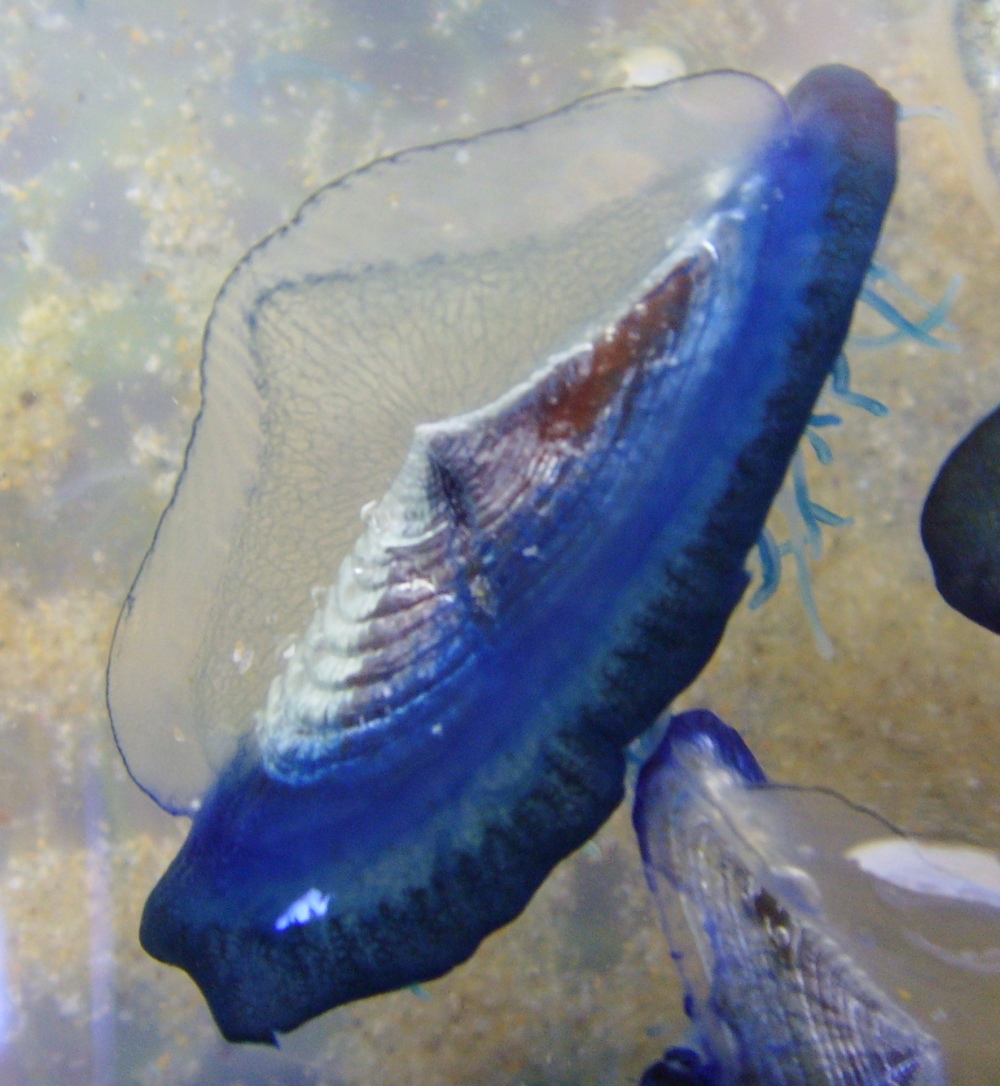
Jymm. public domain
Small relatives of the better known Portuguese Man-of -War this member of the pleuston (organisms that live partially in and out of the water) is often cited by fisherman as an indicator of good fishing. And there may be some truth to fisherman's observations: where you have currents and winds combine plankton will tend to congregate and hence fish to feed on the plankton. Additionally, strange Mola mola (largest bony fish in the world) also love to schlurp up these guys.

So what am I suggesting, Spinosaurus was a pelagic drifter of the high seas? No, no, no, no not at all, this is a bit of a red herring, but I did want to get your minds thinking about ways in which organisms can move with an economy of motion to reach food concentrations.

First off, based on the new material both use as radiator/temp control and use as a hump or fat store are unlikely due to the lack of vessels and muscle scars. So we can eliminate those possibilities. And before I get to what I interpret the sail was for I think it worthwhile to ask why we assume the sail was largely above water level at all? And so far, if you look at just about every popular image of Spinosaurus in the water (such as the awesome image by Bonadonna below) the sail is level with the water line or well above it with much of the torso out as well. This is also the manner in which it is interpreted by Ibrahim et al 2014.

Davide Bonadonna (c) used w/permission
But it should be stated that the sail prominently displayed is an assumption that has not been tested and there is plenty of reason to in fact question it. When we look at other large tetrapods in the water, even humans, only a small percentage of the body is above water. This is especially true when the animal is not swimming and not providing any forward propulsion lifting the body above water. Sleeping sperm whales for instance. And those thick bones, don't forget the bones in the leg and dorsal spines of Spino were thick (Ibrahim et al 2014).
(c) Wild Wonders of Europe
And my favorite - look at the way crocodiles will often use erect posture in the water or when using foot propelled locomotion. I have often thought the greater range of motion crocs use in the water than on land betrays the more varied and athletic maneuvers of their ancestors.

(c) Zebraduiker. Zoochat
My main point here is that is far as I know there has been no detailed study to determine where the sail sat when the animal was in the water at a neutral posture. Possible routes of investigation could include detailed study of all the bones; is there evidence for extensive air sacs; computer models; how swimming would interact with posture (foot and/or tail calculations)? So far I know that the long bones were very solid and in fact the bones in the sail were fairly solid too (Ibrahim et al 2014). Basically many options are on the table and having the sail fully exposed is an option just as defensible as putting most or all of it underwater.

Davide Bonadonna (c) w/permission

An argument can be leveled against the purported benefits of having the sail exposed as a social signal at all times. There are in fact many times where you don't want to be seen. If we imagine Spinosaurus as moving through several different eco-morpho-ontogenetic stages through its life; and if we infer the potential for cannibalism/mate/territory competitor antagonism in a large bodied, weaponized, and reptile brained archosaur; I would say the potential for intraspecific violence is high. But you may disagree.

If we look at highly combative male lions they are not born fully tufted - it grows in with larger bulk. There are many good reasons to be less visible - especially if your neighbors might kill and/or eat you.


But for my purposes here I am going to argue the predominant position when neutral or swimming slowly would be with the sail largely underwater. As I said earlier all options are on the table at this point. And with the largest bones and greatest muscle mass in the caudal region and the smaller forelimbs and lungs in the anterior of the thorax this is a tenable position.

(c) Marco Auditore From Theropoda c/o Andrea Cau
Ibrahim et al 2014

Now above are the two independently arrived at skeletals based on material and approved from the peer reviewed paper Ibrahim et al 2014. As such they are the best current reference for Spinosaurus aegyptiacus until further detailed studies/papers reveal otherwise.

A funny thing happens when you rotate both picture so that the eyes and retracted nares align with the surface of the water in the manner many amphibious tetrapods do (frogs, beavers, crocs, otters, capybaras). (Of course I am a luddite and had to print out the pics and draw on the water level and then rescan - but someone skilled in photoshop should do a better job)

Rotated image so that nares/eyes are above water (c) Marco Auditore

Rotated image Ibrahim et al so that eyes/nares are above water

Now that looks interesting and is not at all too dissimilar to a pose crocs often go into when in the water. And it lets the animal both breathe and watch the top side - which there are some obvious and real benefits to do so. Additionally you will notice the snout is still in the water allowing sensory input from the water to be collected.

(c) Davide Bonadonna used w/permission
Notice that in this posture foraging via the snout and forelimbs is still an option even in deep waters. In murky/vision limited waters/nocturnal situations this is one of several foraging possibilities (but not the predominant foraging strategy as I will argue later). And again, this foraging strategy is none too dissimilar to a noted foraging strategy of saltwater crocodiles C. porosus.. Crocodylus porosus (Saltwater Crocodile). Fishing Behavior


A further line of inquiry investigating possible tactical feeding would be to look for signs of enervation in the forelimb/hand.

Getting back to this posture in the water and what the hell the sail was up to is to coming up next but beforehand to complete my picture I find it useful to give a little context to the tidal/estuarine/deltaic/fluvial mosaic systems that Spinosaurus aegyptiacus resided in.


This is the East Alligator River in Northern Territory Australia. As a large, tidally influenced, river on a coastline neighboring a large tropical ocean with a monsoonal climate regime I think this environment offers some good context to the habitat of Spinosaurus. As you can see from my measurement ( I use GEOlocate) the river mouth is over 5 km wide. You will also notice the network of side tidal creeks/oxbow lakes/ backwaters/billabongs creating a rich labyrinth of varied aquatic habitats.


What I measured here is the distance, as the crow flies, from the river mouth to Cahill's Crossing which is over 55 km.


Cahill's Crossing is the main road connecting Kakadu and Arnhem lands. But depending on the tides and floods crossing can be dicey as the road essentially goes through the river. Yes, there is significant tidal influence at Cahill's of several meters despite it being over 55 km from the river as I mapped on GEOlocate. During periods of rising or lowering tides the road acts as sort of a choke point for fish coming or going out with the tide. And attracted to those fish are two competing predators - Homo sapiens and Crocodylus porosus. By all accounts the croc seems to fare better as a fisherman here, especially for barramundi,  highly coveted by both animals. And sometimes H. sapiens loses more than just a 'barra here.

(c) BOBINOZ
What I want to illustrate is how important the tidal influence is on the organisms that inhabit these tidally dominated rivers - both in terms of the daily rhythm they set and how organisms move with the tide for feeding opportunities. And this is true whether it be the small fish/crustaceans moving in to feed in the shallows or the large, larger, and largest predators that move in to feed on them. And how adept predators can hone in at certain choke points or geographic funnels that fish have to move through in order to not get stranded with the lowering tide. Adept human fishermen of tidally influenced habitats use this very knowledge of how tides and topography can create significant influence on where fish have to move through and they take advantage of it. "As the tide begins to fall, the water coming off these flats begins to funnel into small channels, leading into larger channels and eventually into the creeks and rivers. Fish sense the dropping water and will move out with the tide to deeper water. These tidal outflows to deeper water are where fishing can be great." Ron Brooks, Fishing with the Tide. 

Simply put, you need to go where the fish are.

East Alligator River tidal tributaries
And I will suggest  Spinosaurus aegyptiacus was especially adept and skilled at finding and exploiting these tidal outflows/inflow channels.

By concentrating at these particular spots where the fish have to come to it Spinosaurus aegyptiacus could key in on a particularly easy, dependable, and rich food source. Note as well in this scenario  Spinosaurus is facing into the flow of water. Fish have to swim past it to either rich feeding areas with the incoming tide or go past it to escape the out-flowing tides. And if the jaws do not get the fish the hands - behind the jaws of course - still get a shot at passing fish or can assist with gaffing larger ones. Seen in this manner oncoming fish have to face a gauntlet of gaffing hand claws or rosette toothed jaws. Of the neck Ibrahim et al (2014) noted "The horizontal cervicodorsal hinges created by these broad centra facilitates dorsoventral excursion of the neck and skull in pursuit of prey underwater." Of the forelimb it "has hypertrophied deltopectoral and olecranon processes for powerful flexion and extension." and "that the manus is proportionately longer than in earlier spinosaurids."

What I envisage is an animal that had a predatory strike a bit like a xenomorph, fairly long fingers with gaff hooks, and a hug that you did not want to be the recipient of. With the long neck, dorsal sail, relatively flexible tail and immense size and length these guys could block off entire creeks pinning outgoing fish in a death trap formed by its own body. Again crocodiles are known to do this (on a smaller scale).

(c)Holmesontheroad. Saltwater Croc at Cahills Crossing Northern Territory Australia

In this discussion it should not be left out that current thought is that the moon has been moving away from us, stealing rotational energy from us (via tides) and giving us longer and longer days. Following from this there is potential for much greater tidal swings in the Cenomanian with both a higher maximum tide and a lower low tide. I don't know or have any data on how much bigger it was then but I did find this interesting discussion on the old DML where a suggestion was made for potentially high tides adjacent to the Tethys - take it for what it is. I would like to look more in depth at this issue.

And finally the sail. I am going to maintain that the pose I used above is a nice approximation for Spinosaurus aegyptiacus in a neutral relaxed floating/slow swimming position. The observations that; most large amphibious tetrapods maintain most of their body under the water; the eyes and nares both naturally surface in this posture; and that the thick bones, heavy caudal musculature, and buoyancy of the lungs/lighter forequarters may likely dictate this posture are my main reasonings.


And in this neutral swimming posture I am going to suggest that Spinosaurus aegyptiacus used the sail to ride tidal currents with both the rising and lowering tides to reach choice feeding opportunities.* Both tail and/or hindlimb could assist in movement and/or direction. With pedal/tail propulsion the body - and therefore the sail - can best be directed in a manner most useful to the animal in terms of where it wants to go. It has not gone unnoticed that the strange morphology of the sail may offer hydrodynamic properties that would further support this hypothesis and this may be a fruitful area of study to anyone with better physics knowledge than myself. This underwater sail interpretation also is suggestive of a method of dispersal via ocean currents. Again saltwater crocs use currents and tides to their advantage in movements in rivers and oceans. A quote from Dr. Campbell who tracked the movements of saltwater crocodiles (link), "They have an extraordinary ability to calculate the direction the currents are flowing and whether they will take them in the direction they want to go." additionally "We (were) looking through the data and found their movements correlated with the tidal flows in the rivers and that they were getting out onto the river bank when the tide changed direction."

Note that this interpretation does not preclude the use of the sail for social cues. But as I argued earlier there are often very good reasons to remain hidden. If you are the king of the estuary - or a hopeful to the throne - then I can well imagine you blowing yourself up as big as possible especially by exposing that big sail. Again, crocodiles do a similar thing inhaling air and ballooning up bigger.

Another critique I will offer is that bone is expensive to grow and maintain. If visual signaling is the primary use for the sail why not have a couple of thin rods of bone with just skin. Like a sailfish?

sailfish. Benjamint444
All in all, as you can probably guess, I would elect the saltwater crocodile, Crocodylus porosus, as the most useful analogue to Spinosaurus aegyptiacus. Basically a saltwater crocodile writ large, S. aegyptiacus, had the advantage over the croc in terms of relative strike range via the neck and gaffing forelimbs. I interpret the sail as being largely underwater bringing the nares and eyes above water level. The sail, used to take advantage of currents/tides, furthermore offered an energy efficient mode of transport and dispersal.* Like the saltwater crocodile I do not interpret S. aegyptiacus as a particularly good pursuit predator and the relatively stiff thoracic region do not speak to the nimble maneuvering useful in aquatic pursuit. Instead non-visual detection of prey via sensory receptors in the snout and possibly hands was predominate encountered during stalking/drifting (esp in turbid/nocturnal conditions); and adept use of physio-fluvial constraints (i.e. banks/channels/tidal constraints on fish movement) offer more pragmatic and economic options in foraging behavior. Foraging on terrestrial sediments was likely not important as the skeletal features outlined by Ibrahim et al (2014), especially diminished pelvic region, suggest terrestrial movement was not important to S. aegyptiacus. Underwater running in a classic bipedal  theropod mode was likely predominant mode of locomotion in shallower waters (although still potentially pretty deep) where the feet could touch down. 

Again you may differ in your interpretation, or you might not be convinced Spino was this aquatic -that's ok. You might not like my approach but I think the picture I have conveyed is very believable and in line with the known anatomy and environment of Spinosaurus aegyptiacus, and not without analogue. It offers a foraging and dispersal strategy exceptionally thrifty and energy efficient. And all in all I can't help but mention this picture I have painted speaks to a far more interesting, nuanced, and amazing animal than anything suggested so far.

And finally here is a young Homo sapiens imitating a saltwater crocodile/spinosaur in a tidal creek in Australia.


Cheers!!

*Update 9/21/14 After receiving some valid criticism regarding the use of the sail to be pushed with tidal currents I have changed my thoughts. The reason for this is that unlike a sail in the wind being used to help push along an object on the water - a sail in the water being used to push an object already in the water is not necessary. The body will float along naturally anyways with the current as the body is less dense than the water it is immersed in. This still does leave open possible hydrodynamic properties for greater maneuverability via the sail, and using the tides for movement is a possible strategy, and I do think in a neutral floating/slowly swimming position much of the sail would be underwater - but further tests are needed.


Support me on Patreon.
Like antediluvian salad on facebook.
Watch me on Deviantart @NashD1.Subscribe to my youtube channel Duane Nash.


Saturday, August 16, 2014

Did Bakker Get Spinosaurus Right After All?

Roll with me for more Spino madness in my book Dinosaur Enlightenment: Piercing the Veil on Kaiju Dinosaur in an Age of Disruption available on Amazon ebook and soft copy!! https://www.amazon.com/Dinosaur-Enlightenment-Piercing-Kaiju-Disruption/dp/B08M2FZ9GX/ref=tmm_pap_swatch_0?_encoding=UTF8&qid=&sr= *Update 9/23/14 As this post continues to get heavy traffic it should be noted it was first posted (8/16/14) before the official publication of the new Spinosaurus aegyptiacus material (Ibrahim et al., 2014) but I will leave it as it was originally posted. That being said I have seen nothing in the new material, nor the arguments against it I have solicited online, that would disqualify it as one of several terrestrial locomotory styles possible to this animal. Indeed I think based on the ontogenetic stage of the animal as well as the substrate the animal is on many locomotory styles were utilized. This ability to switch locomotory styles is well documented in crocodiles especially with regards to size and substrate. Additionally, as some have objected, what I am proposing is not a radical overhaul of known theropod anatomy but simply a co-option of known theropod resting anatomy. As such, belly sliding - which is utilized by several amphibious/aquatic  members of both extant archosaur lineages (birds/crocs)  - with possible use of the forelimbs in a "combat crawl" motion still remains a viable, and in my opinion robust, hypothesis for terrestrial locomotion in this animal.

We all know and love the new Spinosaurus aegyptiacus reconstruction right? "Disenchanting" is how Douglas Henderson described it on facebook. And it does fall a little bit shy of the impressive dual land/water arch predator it has so often been posited to be, especially since a little movie came out (JP3 duh) and our friend the Spino terrorized everything from T-rex to estranged parents. Truth be told it looks a little clunky, a little too front heavy to work right - at least the way we expect theropods to work  since GSP started drawing them as svelte athletes rip roaring across the page. So, yeah I do want to comment on the new Spino reconstruction and yeah there are a lot of people - very knowledgeable ones at that - that would definitely disapprove of what I am going to do before publication of the new material. But I will argue that my interpretation on what was going on with Spino is in fact presaged by what we already know from other members of spinosauridae and yes, as suggested by the title, I think Bakker got the jump on all of us by suggesting way back when that Spinosaurus was a lot more aquatic than generally portrayed. But I will offer my little Antediluvian Salad spin on Spinosaurus and hopefully you find it interesting. And leave a comment.


Moss Landing/Elkhorn Slough US Army Corps. public domain
Before I get to Spino itself I want to tell a little story to help illuminate my point. A little tale about kayaking. I do like to kayak and one of the funner places to do so in California is a place called Elkhorn Slough in the Monterey Bay. It is a tidally influenced estuary and there is always open access to the ocean, especially because of the harbor at the entrance having to be maintained. It is noted for the unique population of sea otters that forage in an estuary as opposed to the ocean - often times within view of the highway that crosses the estuary. These estuarine sea otters have been shown to predate heavily on crabs and, in a classic trophic cascade, have bolstered stands of eel grass in the estuary. In addition to the otters, there are loads of harbor seal, water birds and miles of watery inlets to explore. It is the type of place that lets you imagine the California that once was - when coastal lagoons and estuaries dotted the entire coast, flocks of birds blackened the skies and grizzlies patrolled everywhere. Elkhorn Slough is so spellbinding in fact that as I kayaked it I lost track of the depth of water I was in and became grounded in mud in shallow water. This sucks I thought to myself as I considered the possibility of having to get out and push my kayak back into deeper water. Thankfully cooler heads prevailed. I did not make the rookie mistake of getting out of the kayak where I would have likely got mired waist deep in tidal mud in a sulphurous mess. In our best impersonation of saltwater crocodile plowing through tidal flats we shimmied left and right and paddled with short quick thrusts to get back to deep water. And if you imagine the long rounded body of the kayak as equivalent to the long low body of a crocodile, seal, or otter the analogy of moving through deep/sticky mud in a kayak is spot on. And if you think of large amphibious tetrapods moving through the mud, and I am talking deep/miring mud, they all get low and down in it and use their body surface area to prevent sinking too deep. Go look at saltwater crocodiles steaming through tidal mud flats in Queensland.


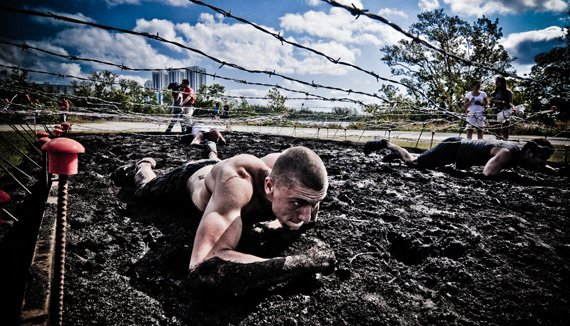
Large tetrapods that do not use this technique in deep mud risk getting mired. For large bipeds the risks are even more extreme as all of the weight is concentrated on just one limb when pushing off. As the picture above attests a very large American crocodile has some advantages over a bipedal hominid in deep mud (he survived btw). Whether you are a trained soldier or a simply like to take the Spartan Challenge one is quick to see the benefits of getting down into the mud to get through it. It might seem counter intuitive at first but just ask this guy.


Now following this line of thought of how to traverse muddy areas as a large tetrapods let us revisit Spinosaurus aegyptiacus - especially with respect to the new reconstruction c/o Paul Sereno.

Nat Geo
So we got a couple things going on here. A very long, low body with some ridiculous looking shorty-shorts legs. Especially reconstructed in the Paulian push off mode the beast looks seriously in danger of tipping over. Combined with the strangely down turned head and the heavy arms the question is begged is this manoeuvre even possible? To further complicate the issue let us put this animals in its habitat - tidal/deltaic wetlands. (insert discussion on spinosauridae habitat choice, diet, you can find the evidence is compelling!) Now we have the issue of a massive, bipedal animal in a habitat full of mud - as discussed earlier large bipeds in thick mud can be an issue. What was the poor spino to do? What I am going to suggest is that Spinosaur and its ilk went to boot camp and learned how to combat crawl. Not entirely quadrupedal but not entirely bipedal but a bit of a compromise between the two. Lower the torso, push off with the short back legs - a bit like a penguin actually - and the coup de grace those bizarre and massively boned and muscled forelegs. Simply fold them in the manner all theropods are now known to do. The radius and ulna take the weight and the clawed digits are curled inwards. Take a look at this pic c/o Dave Hone of a Suchomimus arm. Spinosaur arms were robust but not as elongate as often depicted. But when the spino goes into this belly slide I will suggest the arms can assist in kind of a "combat crawl" motion. The elbow is where the movement happens and the radius and ulna take the weight.

Seen in this manner the long low torso, short legs, short but powerful forearms, and downward sloping neck shared by all spinosauridae now start to make sense. Chasing after stuff on terra firma these  animals were not. But if you were in the water, or a hapless dinosaur mired in the mud, spino could get the jump on you.

Duane Nash
Above is a very quick and punk rockish sketch I did yesterday of a spino moving through thick tidal flat mud. The black color on the underside is not some type of reverse countershading but the thick/clingy mud you find in such environments. I have been drawing theropods on and off for over 20 years but drawing spinosaurids you have to sort of unlearn what you are used to. Not tall and gracile, no graceful S-curve to the neck, not a compact torso but a long barrel shaped torso. They seem to go against the "birdy, svelte, uber athletic" theropod bauplan that has dominated reconstructions essentially as a result of Gregory S. Paul's influence. Hence the culture shock at the new reconstruction of Spinosaurus. In hind sight maybe we should have seen this coming. All of the known relatives of Spino tip forward a bit, have short heavy arms, and well just look oddly proportioned compared to other theropods. Spinosaurs took these attributes to the extreme. I would suggest all spinosauridae would utilize belly crawls in muddy situations and perhaps occasionally even on dry land. If you look at the list of large amphibious tetrapods that do not utilize the belly slide in thick mud the list is basically.... nil? Maybe hippos don't belly slide, but they do have four short powerful limbs and a long torso. Capybaras?


Below is a depiction I did of Spino with just the body showing and not obscured in the mud. It is a little difficult to draw as such and work kinematically where everything goes. But I think such a style of movement is a fair compromise considering what we know from these critters anatomically and ecologically.

Duane Nash
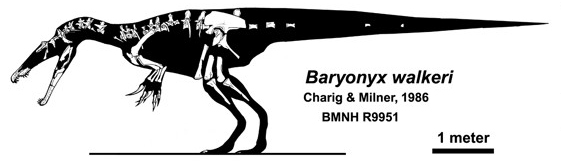
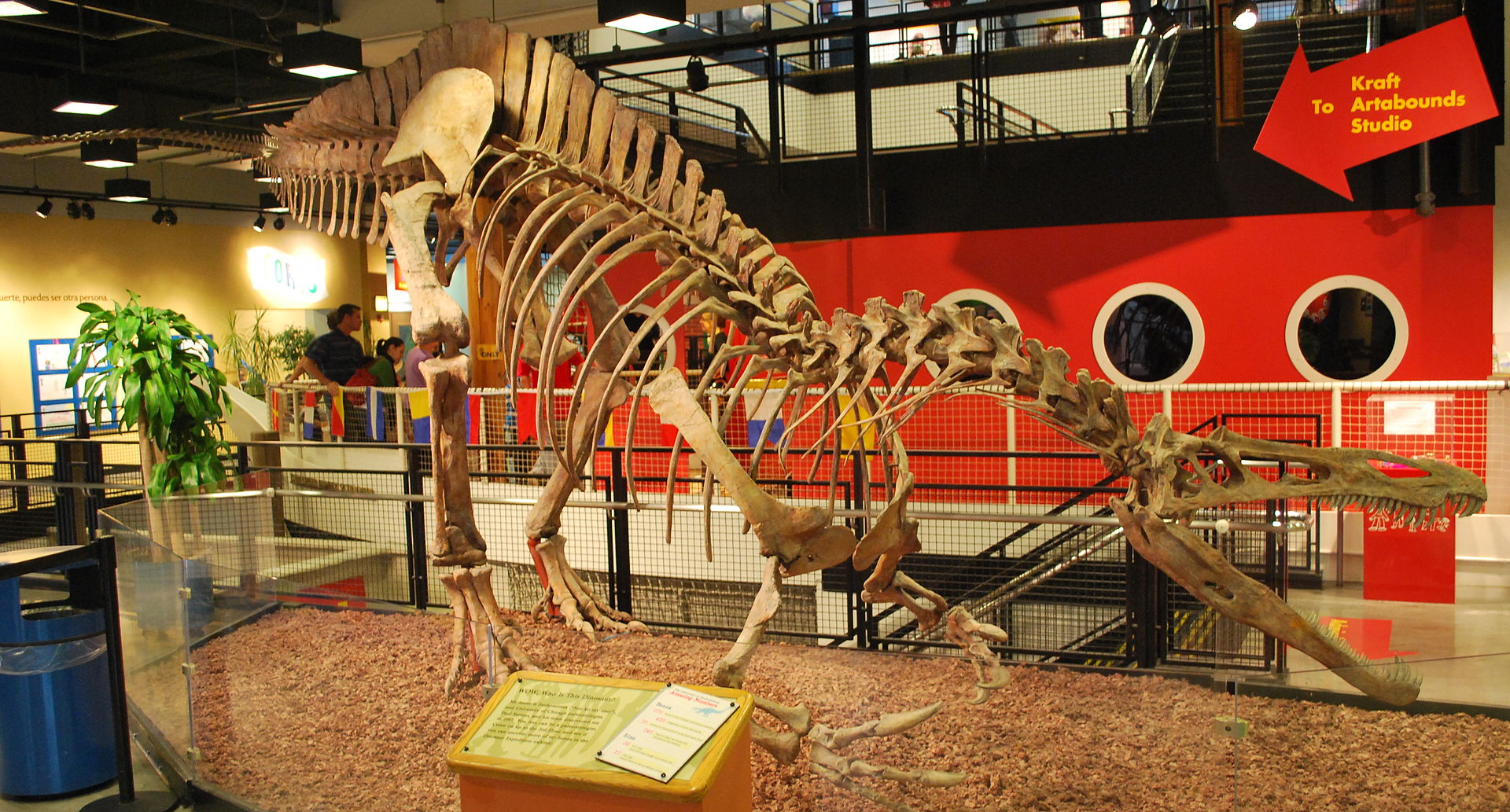
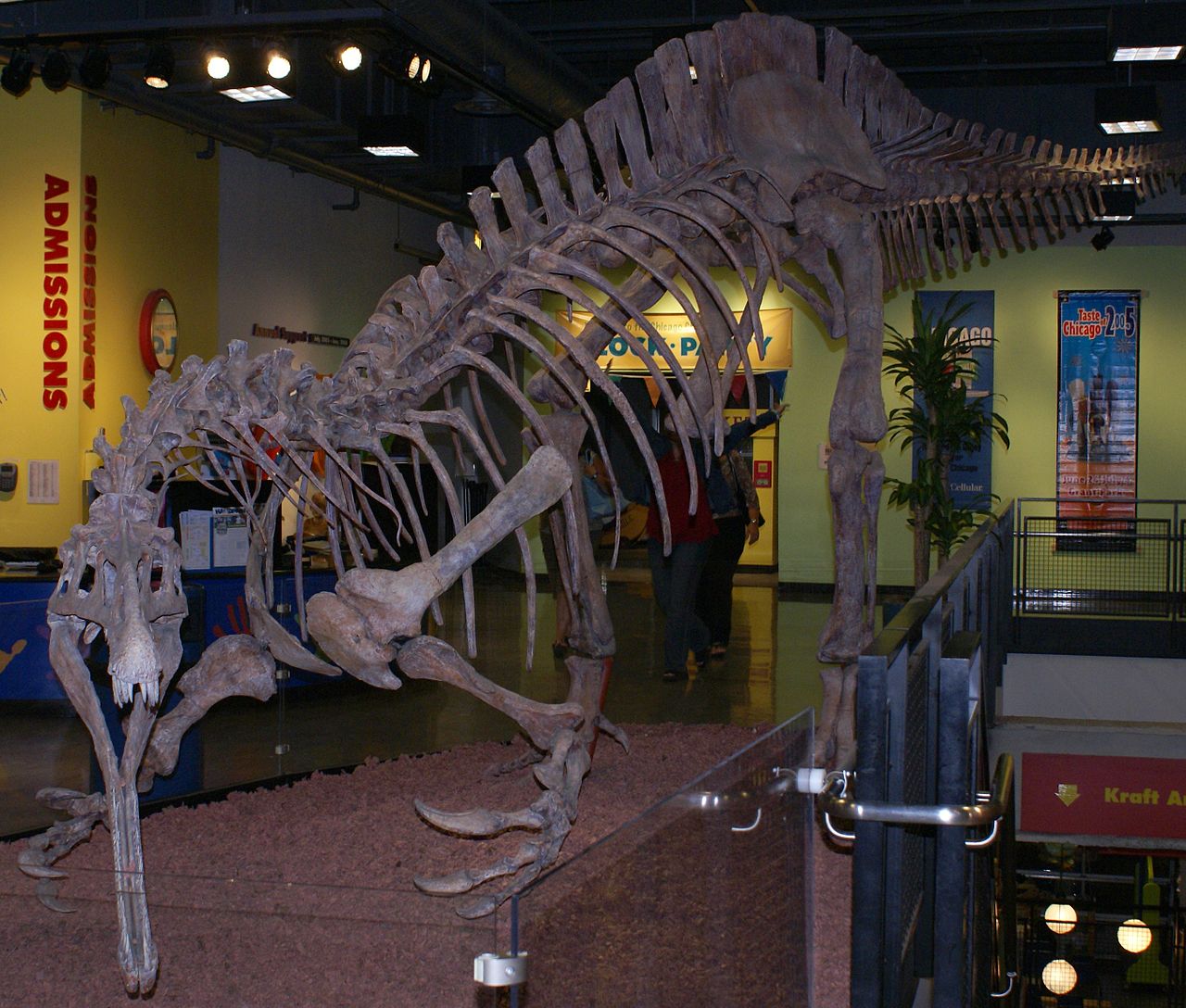
And again let us just look at the skeletons of other related spinosaurids. Like I said earlier some take objection to me writing about Spino before the publication but if you look at these skeletons in light of the argument I just put forth for belly sliding/combat crawling there is no reason to say that they may have all been doing it. And I seriously doubt Sereno and Nat Geo are going to suggest this mode of movement because, you know, they put their mount in a Paulian push off extreme cursorial stance. And finally Robert Bakker was suggesting that these guys were a lot more aquatic than generally portrayed. And usually ridiculed for his opinions. Last laugh may go to Bakker on this one.

As for how they moved in the water I think more or less like a hippo but bipedal running underwater. Not tail driven.

Subadult Spino. wiki. legs were likely shorter. Creative Commons Funkmonk
Baronyx walkerii. CC Funkmonk. Note heavy, but short forearms

Above is a skeletal by blogger/artist/researcher Jaime A. Headden. You will notice that of the material we have, the lower legs are missing. Never the less, as in this skeletal, they are usually rendered fairly long and gracile. But they may have been quite a bit stumpier.

Suchomimus tenerensis. CC AStrangerintheAlps
Again with Suchomimus we see that tendency to fall forward a bit. Almost as if it is begging to go belly slide in some primordial ooze.

Suchomimus tenerensis CC Belinda Hankins Miller

Getting low, getting low.


Support me on Patreon.
Like antediluvian salad on facebook.
Watch me on Deviantart @NashD1.Subscribe to my youtube channel Duane Nash.


Related Posts Plugin for WordPress, Blogger...