Showing posts with label ceratopsids. Show all posts

Sunday, July 14, 2013

Laramidian Dino Morpho-Eco-Head Space Trippin'

* New data has come to light on ceratopsid biting mechanics. I no longer subscribe to the view I espouse here. Update 11/5/13

Available for free here on PLOSone is a new paper analyzing the ecomorphology of some herbivorous dinosaurs from Dinosaur Park, Alberta Canada dating to the Upper Campanian of the Cretaceous. The authors developed 5-6 distinct ecomorphs from the 12 herbivorous dinosaurs examined. They analyzed the skulls based on size, width, ventral deflection of the snout, distal extension of the tooth row, and depth of the mandible. The paper addresses the ongoing debate on how such large and diverse megaberbivores coexisted in such exceptional diversity on the relatively small island continent of Laramidia.

I have talked about Laramidia before here on Laramidia: The Great Dinosaur Species Pump. I discussed a paper suggesting transverse mountain building events- orogonies- as providing a geographic barrier promoting dino vicariance speciation events and ultimately great diversity. I also theorized in that post that nest site fidelity may have worked in coupling with mountain building to further promote dinosaur speciation.

Now keep in mind that the question of dino diversity on Laramidia, like many complex questions, is not necessarily an either/or one. That is, it is not necessarily a simple one answer question. Just because niche partitioning was occurring does not mean mountain building/isolation did not play a role and vice/versa. Never-the-less the paper does add another layer to the debate and I suggest you read it before you move forward reading this post as I do not want to write a simple summary but address some of the more pertinent points in the paper as they relate to my own opinions about dino faunas of Laramidia.

(c) Julius Csostonyi
First of all, here is where I think the paper left me wanting more in several spots.

Where are all the small guys? Now I know people love big stuff and dinos were big stuff but the more we look at these faunas the more diversity of smallish dinosaurs we uncover. Dinosaur Provincial Park was no exception with lots of small to medium sized ornithomimids, pachycephalosaurids, oviraptors, various ornithopods, and probably some other stuff I am forgetting. How important were these guys ecologically? I don't know. Fossil bias likely skews the preserved remains in favor of large dinos like ceratopsids, ankylosaurids, and duck-bills- which happen to be what the study focuses on. Furthermore our friends the ankylosaurs are given the ecomorphological treatment like the ceratopsids and duck-bills but as the authors mention themselves they could not conduct much statistical work on ankylosaurs as the sample size was rare. There it is again, rare but ubiquitous ankylosaurs. Maybe ornithomimids were more important herbivores in DPP than ankylosaurids? Predation pressure and fossil bias likely account for larger species being preferentially preserved. Additionally, due to their R-strategy reproduction, the populations  was likely skewed towards smaller class sizes- but the paper does not address how these subadult/teenage/hatchling dinos acted.

I don't know maybe it was the dataset that they were forced to work with but any more complete approximations of this ecosystem include how smaller dinos/immatures fit into it.


Scant attention is given to the vegetative community. The authors briefly mention the paleo-flora but argue that much of the flora alive at DPP is also found today and their morphometric study is not invalidated by this fact. No argument from me on this one but I believe it is imperative that we perhaps acknowledge that the environment of DPP, a high-latitude subtropical biome, is one we have no modern proxy for and how herbivores exploited this environment will likely invoke animal ecologies we likewise have no modern proxy for. Did plant growth slow or just stop mid-winter with only 7-8 hours of day? Conversely during the summer there must have been a riot of growth...

Again, these are not so much criticisms of the paper- you can only do so much in one paper- but just some ways I think we can see and understand DPP in more resolution. I do applaud the work put in and it appears very solid in terms of showing how these various subfamilies partitioned the resources. But here I do see a little bit of problem in that the language and tone of the paper is couched in terms of "competition" i.e. how did the herbivores coexist? They minimized competition by eating differently on different plant types the paper suggests. But is their another way to look at how these herbivores coexisted?

Consider a beaver pond in modern day Alberta, Canada. You have a beaver which creates the habitat of the beaver pond and directly enhances it for other creatures. One such creature that directly benefits from the beaver pond is moose, attracted to the luxuriant growth and aquatic vegetation. Now the moose and beaver have significant dietary overlap, leaves/branches of cottonwood, poplar, and willow for example. There might be some truth in saying that they compete for this resource. But at the same time the moose disproportionately benefits from the actions of the beaver by the beavers' creation of ideal habitat providing a great example of commensalism. Where Beaver Lead, Moose Follow.


Imagine, if beaver and moose were extinct before paleontologists came about, the problems in elucidating this relationship between moose and beaver for a putative paleontologist. You keep finding this seeming cohabitation beween moose and beaver in the fossil deposits. One a short, stubby, squat rodent equipped with massive incisors and browsing dentition. The other a spindly legged quadrupedal browser. You might wonder how this little critter made its living...how could it get away from predators?....why those teeth?....it certainly could not reach very high into the vegetation. What about the moose? An upland browser maybe washed into wetland settings? Would you ever arrive at a strong seasonal aquatic habit for it? Did the two compete? partition resources? What problems might you encounter in getting to the relationship between moose and beaver? Would you ever?

Now let's get back to the question of Laramidian dinosaurs with the example of moose/beaver commensalism in mind. Currently much of the debate concerning Laramidian megaherbivores centers on niche partitioning i.e. how they minimized competitiion. But let's reframe the debate and allow for various levels of competition, niche partitioning, and commensalism all possibly taking place- maybe even concurrently.

In the paper the authors note that the morphometric breakdown suggests discrete herbivorous adaptations among the families and subfamilies. One of the more interesting aspects of the species breakdown is that the pattern of herbivore types represented at DPP tends to repeat over time remaining stable. That is these "chronofaunas" keep stable even as the individual species change. For example a fauna will likely contain maybe one nodosaur, one ankylosaur, a chasmosaurine, a centrosaurine, several  lambeosaurine, and maybe several hadrosaurine types. But you never see the fauna dominated by a single morpho-type; for example you never see five or six lambeosaurines but no chasmosaurine. That these distinct morpho-types keep repeating in a pattern is indeed, as the paper suggests, consistent with niche-partitioning; but let's examine this trend of "chronofaunas" not from a perspective dominated by competition, but one in which commensal relationships dominated.

Let's address the issue of megaherbivore diversity from the perspective of "keystone" species- species that have dramatic influence over the whole ecosystem. And the keystone species, I purport, in DPP park were the ceratopsids. A few posts ago in The Devil's Chewtoy I spelled out my view of ceratopsid paleo-ecology. I envision ceratopsids not as archosaurian rhinos/buffalo but as giant, terrestrial parrot/beavers. These guys, I suggest, were using those over-sized heads, parrot beaks, and stout builds to chew up and topple trees and then have their pickings
of the best browse. Seen in this light ceratopsids were not ungainly rhino-wannabes in an awkward foreleg half push up. Instead that unique stance, rostral beak, and robust build bespeak an exquisitely adapted tree toppler. Indeed the authors in the paper characterize ceratopsids as acting as browsers from their analysis but are perplexed that the scope of browse is limited to the first meter of vegetation. But if ceratopsids brought the browse down to their level the problem is solved.
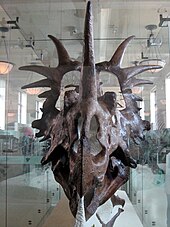
One of the more intriguing issues in dinosaur biogeography is the scarcity of ceratopsids in Asia despite it being connected to North America (with abundant ceratopsids). Could the prevailing arid conditions of Asia not have provided enough trees for ceratopsids? We don't see guys like Sinoceratops in China until things get wetter. Additionally although hadrosaurids seem to have penetrated into South America, ceratopsids were either absent or extremely scarce in colonizing South America. Could an equatorial arid belt prohibited their migration into the south? To add another layer to my argument remember there are no clear high browsers in DPP. No sauropods, not even any especially tall therizinosaurs or ornithomimids. Is it not a little weird that some of the best paleoart of DPP shows all these low slung herbivores walking underneath towering, unexploited trees? But tree toppling ceratopsids adequately fulfill that seeming ecological vacancy.

Seen in this light ceratopsids were the engineers of these ecosystems. They would have moved into forests and toppled trees. The effect would be to lower the browse level not only for ceratopsids but for any other dinos that wanted to partake; maybe bands of lambeosaurines followed along the ceratopsids waiting for a leafy dinner. Abundant root sprouting/coppicing would commence for redwoods and angiosperms providing abundant browse in reach of herbivores. Additionally this tree toppling would have created open areas with sun penetration that benefitted lower browsers and grazers like big wide mouthed ankylosaurs and hadrosaurids.  Remember those wood chomping hadrosaurs I talked about in Rot n' Roll in the Mesozoic Muck? Yeah tree toppling ceratopsids would have benefited them as well... Maybe ceratopsid tree cutting set a whole ecological cascade in motion of forest succession ultimately creating and enhancing habitat for a whole myriad of dinos. plants, and other critters? The point is you can imagine all kinds of unique ecological corollaries based off of ceratopsid tree toppling.

And if ceratopsids were the lumberjacks/forest clearers of Laramidia, ankylosaurs were the janitors.

As I talked about in Ankylosaurs Are Still Weird I believe these guys were up to eating all sorts of weird stuff. Not saying they did not eat stuff like ferns, fruits and stuff as preserved in the oolite of Minmi, but I believe the Mesozoic offered up ecological opportunities just not found today which these guys capitalized on. You have to imagine that these subtropical high latitude environments with abundant water were interesting places without exact analogue today. During those long, hot summer days plant growth was likely off the charts. And then during those winter months you have all those deciduous plants, leaf litter, dino dung, moisture- it must have just been rife with fungal growth. Ankylosaurs may have relished those fungal treats. Additionally stuff like dung, rotten dead stuff, insect hives, eggs,  detritus, tree sap, roots, fruits and bones were possibly delectable tid-bits for ankylosaurs. They were, in my view, like walking compost bins with their adept smell leading them to their next toxic meal eagerly slurped up with their robust tongues.  Ankylosaurs kept the flow of nutrients going hard and fast in these super-charged Laramidian ecosystems in my view.

And the hadrosaurids in my view were the middlemen ecologically. Relatively narrow snouted lambeosaurines perhaps benefited in the forest regeneration stage where browse was nutritious and within reach. Wide beaked hadrosaurids, along with wide mouthed ankylosaurs, likely thrived in recently cleared areas. Periodic fires would have cleard excessive debris and stimulated new growth. Ornithomimids, pachys, and small ornithopods likewise exploited these putative ceratopsid modified habitats. Tyrannosaurids, raptor type guys, and azhdarchid pterosaurs maintained a strong top down influence preventing the herds from overbrowsing, keeping the ceratopsids moving, preventing clear-cutting, and allowing forest regrowth. Egg eating lizards, mammals, and ankylosaurids would have also checked explosive herbivore populaiton growth.

Anyways, those are my thoughts on how some aspects of the DPP ecosystem functioned. I know it is not a typical color by the numbers approach and, as always, highly speculative but I do believe what I have portrayed is in the realm of possibilities and may offer insight into how to approach these ecosystems.

Doug Henderson sketch for Tony McVey project (c) 2008

Cheers!!!


Support me on Patreon.
Like antediluvian salad on facebook.
Watch me on Deviantart @NashD1.Subscribe to my youtube channel Duane Nash.


Monday, February 18, 2013

'Ceratops Cichlid

Ding! Ding! Ding!


Above is an excellent, and sometimes heated, debate between Dr. Jack Horner- who posits that Torosaurus is the adult morph of Triceratops- and Dr. Nick Longrich- who maintains they are separate species. Both parties bring some very pertinent and compelling arguments to the table- although Horner seems to have the edge in terms of humour and comfortability in his presentation.

Anyone at all interested in dinosaur studies is probably well versed on the compelling Triceratops/Torosaurus debate as it has morphed (hahaha) into one of the more fascinating discourses in dinosaur paleontology. And chances are that if you are reading this blog you are that type of person- if not watch the debate above and the video at the end of this post to catch up. So what this post is about is not a summary of the debate- I am too lazy and have a little too much carpal tunnel syndrome to do that- but I want to describe my take on the issue and how both scientists may actually be right on certain levels.

It is one of the self-evident traits of humans that when we subscribe to an idea- especially if we ourselves take part in the genesis of that idea- that we, almost without exception, become beholden to that idea. And even well trained scientists, armed with sceptical/analytical minds, are not exempt from the potential pitfalls of the "inception" phenomena- and will often hold onto an outdated/disproven theory to the detriment of their own careers.
And so what we have in the above video is a clear line drawn in the sand, succinctly summed up by Horner when he states towards the end of the debate "One of us is right and one of us is wrong". I, as I alluded to earlier, take exception to this statement and believe a third theory accounts for the data as it now stands very comfortably. But to do that we must first talk about fish, specifically cichlids. While cichlids are not what immediately comes to mind when discussing the ontogenetic changes of ceratopsids I do believe that one species provides a useful model for what might just be going on with good ol' three horned face.

Rapid behavioral and genomic responses to social opportunity in cichlid fish Astatotilapia (Haplochromis) burtoni. In this paper a suite of hormonal/genetic changes occur in the male cichlid fish concurrent with achieving/usurping social dominance over other males. Color change occurs on the order of minutes while increased gonad production on the order of 1 week.

"These results show that the rapid behavioral responses to social opportunity were matched by a rapid genomic response in the brain," author Fernald says. "We didn't expect to get changes in gene expression in the brain so early in the process, just 20 minutes after the male has seen the prospect for social change."These results suggest that subordinate males are always looking for opportunities to change, Burmeister adds. "They must constantly be ready, because they make the shift in no time," she says. "They keep track of who's who and who's the biggest so they can take the opportunity to reproduce. An animal that goes through that kind of transition has to recall how he relates to other males, and also has to be aware that he can change. This raises a bigger question about sophisticated social awareness in fish. After all, socialization requires more brainpower, and all vertebrates—fish, amphibians, birds, humans—use a variety of cues in the environment."

All right so probably some of you are seeing where I am going with this- if a cichlid fish can rapidly change both its appearance/behavior/reproductive capacity with changing social status- then could Triceratops males have morphed into Torosaurus upon achieving dominance?
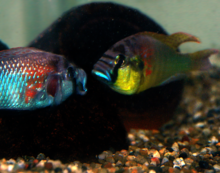
Astatotilapia burtoni males dueling. wiki
And if we look at the data/arguments that both Horner/Longrich site- this scenario of morphological change in male Triceratops concurrent with social change nestles quite nicely.
1) Torosaurus is rare. Both Horner and Longrich agree on this point. And this pattern should be expected if Torosaurus represents the rare dominant male in the population. The vast majority of males, especially in harem forming animals, do not achieve dominance/reproductive success. When they do their time at the top is very limited. In this scenario the vast majority of Triceratops will never achieve dominance and therefore never achieve the Torosaurus morph. As noted by Longrich in the above video we do see very large/old Triceratops which should be expected in this scenario.
2) Lack of transitional forms. If Torosaurus indeed represents dominant male Triceratops then we should expect this morph to be necessarily short term based on what is observed for extant combative male animals. The brevity of male dominance implies the morphological change from Triceratops to Torosaurus morph was rather quick. Not suggesting the change occurred at the same speed as the cichlid changes, but more probably on the order of months rather than years. And this small window of time for transition means that the chances of this transitional state being preserved is rather rare and may never he documented.
3) Young Torosaurus. As noted by Horner we do not see hatchling/young/immature Torosaurus. In my scenario this pattern should be expected because the dominance cues would not kick in until the Triceratops was at least large enough to hold its own against other bulls. Note that this scenario does not preclude still growing/unfused Triceratops to achieve dominance and therefore become Torosaurus morph before full adulthood. Longrich cites examples of Torosaurus with unfused bones/smaller size. In certain circumstances of disease/predation/injury to the dominant bulls even immature males can achieve dominance before attaining full maturity.
4) Ceratopsids, especially Triceratops, do display some characteristics of harem forming animals. Both Horner/Longrich allude to potential dimorphism in ceratopsids which should be expected. The horns, frill, and head gear are the most obvious signals that combative/harem forming social behavior may have been the norm. Keep in mind that ceratopsids were combatting each other as well as multitonne tyrannosaurs. The large billboard of a frill of the Torosaurus morph may have been a warning to other ceratopsids as well as menacing theropods- "Hey you wanna get to those females you gotta get through me first."
Potential problems with my theory. Spatial disparity between Torosaurus and Triceratops. As Longrich points out in the video there does appear to be geographic variation between where Torosaurus is found and where Triceratops is found. He concedes there could be certain taphonomic biases at play as well. Perhaps future work will clear this up. Are fish really good analogues for ornithischian dinosaurs? Some may argue that fish are more basic and less advanced than dinos. I disagree, cichlids especially show complex behavioral processes and group dynamics. Anyone who has kept cichlids as pets would agree. While a change in color is less dramatic than a whole scale reworking of the skull it should also be noted that very small switches of gene expression can result in large scale morphological change.
Although my hypothesis presented here may currently be "untestable" and therefore outside the realm of science I do think it brings a new dimension to the "Toroceratops" debate.
Cheers!!!
Pertinencia
Shape Shifting Dinosaurs. Ted Talk Feb 9, 2012


Article Source: Rapid Behavioral and Genomic Responses to Social OpportunityBurmeister SS, Jarvis ED, Fernald RD (2005) Rapid Behavioral and Genomic Responses to Social Opportunity. PLoS Biol 3(11): e363.doi:10.1371/journal.pbio.0030363

Support me on Patreon.
Like antediluvian salad on facebook.
Watch me on Deviantart @NashD1.Subscribe to my youtube channel Duane Nash.


Friday, August 3, 2012

Laramidia: The Great Dinosaur Species Pump

Recently published in PLoS ONE and viewable online here is a new paper suggesting a mechanism for the incredible diversity of Campanian age Cretaceous dinosaurs in western North America. Because western North America has such a long history of dinosaur excavation and America has long dominated dino science the dinosaur faunas of Late Cretaceous western North America have been assumed to represent the typical dinosaur fauna worldwide. However worldwide dinosaur discoveries have since overturned this notion and Late Cretaceous North America is now seen as the anomalous situation in terms of dinosaur fauna in the global context. As emblematic as tyrannosaurs, ceratopsians and hadrosaurs are- worldwide titanosaur sauropods, derived iguanodonts and abelisaur theropods would have been more typical. And not only is the dinosaur fauna of western North America the strange one, it now appears that the Campanian peak of dinosaur diversity in western North America is a bit of an ecological anomaly in and of itself.

Modern large herbivores are characterized by large geographical ranges often ranging across several ecosystems. Take a look below of the nearly continental range of the African Elephant before large scale human hunting and habitat loss (in grey).


Elephants follow the Jarman-Bell principle in that they are large bodied herbivores and can subsist on relatively low quality fodder- and their range reflects this. However the dinosaurian megaherbivores of Campanian age western North America seem to break all the rules (as dinos often do). Take a look at this map:

A. Late Campanian 75mya B. Late Maastrichtian 65mya

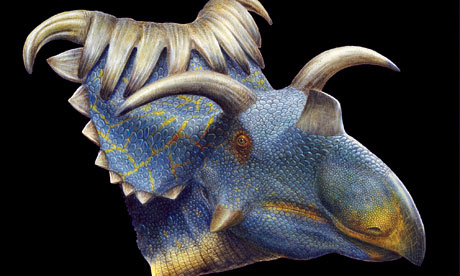
The western "island-continent" of North America in pic A is called Laramidia and is divided by the Pacific Ocean to the west and the Western Interior Seaway to the east. All vying for real estate on Laramidia during Campanian times were up to a dozen rhino sized and up dinosaurian megaherbivores. Dinosaur park in Alberta Canada, for example, documents six to eight large herbivores living synchronously together at various times through the Campanian. Contrast this scenario with what is seen by late Maastrichtian times in pic B where much of the seaway has drained away giving a much larger piece of land to live on. Here we see the iconic "Hell Creek" fauna famous for T-rex and usually containing at most two large herbivores, i.e. a species of Edmontosaur and a species of Triceratops (up in da' salad we do not believe in Torosaurus). Compounding the situation in Laramidia is the recent revelation that there appears to be distinctive north/south faunas of dinosaurs. Recent findings in southern Utah and New Mexico of critters such as Kosmoceratops suggest a division between northern and southern dinosaur faunas in the Campanian that roughly coincides with modern day Colorado and Utah.

Kosmoceratops richarsoni. Copyright Lukas Panzarin

So not only were dino megaherbivores living together in great diversity on Larimidia- these large animals were also showing strong provincialism- individual species were not even spreading across the entire land mass... How ecologically could this be and, more importantly, how did this situation even arise?

What the authors argue is that orogonic activity (mountain building) effected the radiation of large dinosaur herbivore species. Involved are basically two mountain ranges. The first one is the Sevier Mountains which arose in the mid-Cretaceous and trended roughly north-south. Notice also that Laramidia trends north-south. Although a large range, the formation of the Sevier range did not significantly hamper dinosaur movements and there is no great north vs south disparity between dinosaur faunas at the time of its creation. However the Larimide orogonic event, a precursor to the Rocky Mountains, was a game changer. Unlike the Sevier range, these mountains arose longitudinally, east-west. The net effect was to "grid up" the whole of Laramidia, creating numerous small east-west basins hemmed in by ocean on either side. Coincident with the Larimide orogoney is the time of maximal dinosaur species diversity and also evidence of significant north-south provincialism. Long story short geographic barrier is in place and vicariance induced speciation takes over giving us the great species diversity of Campanian dino megaherbivores of Laramidia. When we get into the Maastichtian we see the Rockies start to rise further east, the inland sea drain away, and speciation rate/diversity levels drop off. The dinosaur species pump was turned off by the time of T'-rex.

The authors also speculate that changes in vegetation regimes with elevation/climate would have stifled dino megaherbivore movements between basins. Of course this flies in the face of the notion that all megaberhivores are generalists (something I want to address later)- but I don't dismiss it at face value. Dinos seem to break the rules a lot anyways. And even though there was a much more gradual temperature gradient north-south than in the present- we do see today even in the tropics dramatic changes in vegetation with elevation. Just look at the pic below of Mt. Kinabalu in Borneo, elevation 4, 095 meters (13,435 feet) where you can find alpine and even tundra biomes in tropical latitudes.

It should be noted that the authors concentrated their study on the two main groups of herbivorous dinos in the area- duckbills and horned dinos. This is not to suggest other groups were not following similar trends in radiation of species (dinos or other animals/plants)- its just that the data is best for these guys. Also their head ornamentation allows easy visual discrimination for us and themselves.

One final tid-bit, and this is my conjecture. Many herbivorous dinosaurs show strong nest site fidelity- nesting sites found show evidence they were used for many generations. Two separate populations of the same species with different nesting grounds probably had enough genetic flow between them to maintain species integrity. But now imagine that a mountain range appears that separates the two groups, even if not an impassible one, site fidelity to a nesting ground would further minimize genetic flow between the two populations. And voila- vicariance speciation follows.

Laramidia must have been a strange and wondrous place. A place of incredible diversity, not just of the small but the large as well. Anomalous, even for dinosaur standards, in the ridiculous variety of megafauna cohabiting in time and space. A place where by simply cresting an insignificant mountain pass one might find a whole separate flora/fauna waiting on the other side.


Pertinencia

Dinosaur Boom Linked to Rise of Rocky Mountains
http://www.livescience.com/22116-dinosaur-diversity-rocky-mountain-rise.html

Gates TA, Prieto-Márquez A, Zanno LE (2012) Mountain Building Triggered Late Cretaceous North American Megaherbivore Dinosaur Radiation. PLoS ONE 7(8): e42135. doi:10.1371/journal.pone.0042135

Copyright Sammy @ http://dino-art.blogspot.com/
Support me on Patreon.
Like antediluvian salad on facebook.
Watch me on Deviantart @NashD1.Subscribe to my youtube channel Duane Nash.

 
Related Posts Plugin for WordPress, Blogger...