Friday, October 26, 2012

Cheirolepidiaceae

Frenelopsis teixierae. from Mendes et al 2010. Note similarity to pickleweed at end of post


In visualizing what the equatorial arid belt looked like during the Mesozoic one can not ignore perhaps the most significant aspect of the flora- the extinct conifer family Cheirolepidiaceae. Now when you visualize what these plants were like, don't be limited by what your idea of conifers is in modern ecosystems. The Cheirolepidiaceae were up to some pretty wild stuff for their time.

Paraucaria patagonika cone x-section.


For starters they evolved a mutualistic coevolutionary pollination partnership with extinct scorpionflies (Mecoptera), thus preceding angiosperm insect pollination by over 20 million years. They also developed a wide repertoire of lifestyles including brackish water halophytic specialists, desert specialists, and probably ranged in size from small groundcover types to large trees. They were also one of the few families of conifers to thrive in both the northern and southern hemisphere but were especially dominant in the arid equator. Indeed the presence of their unique pollen, referred to as Classopolis, is often used as a proxy for arid conditions.


It is unfortunate that we do not have today any surviving species of this unique Mesozoic conifer family. But during the Mesozoic we can imagine that members of this family filled many of the niches that modern angiosperms do today- from water plants to xeric dry adapted plants. Indeed the Cheirolepidiaceae, given their insect pollination and diversity of forms, were probably the gymnosperms most like angiosperms. And this congruence ultimately is why this family may have started losing ground to angiosperms and eventually went extinct by the end of the Cretaceous.


Pertinencia

Gomez, Bernard et al. Frenelopsis (Coniferales: Cheirolepidiaceae) and related male organ genera from the lower Cretaceous of Spain. Paleontology 2002.

Mesozoic Floras. Omnilogos. James F Basinger. Encyclopedia of Dinosaurs. Amsterdam: Academic Press, 1997.

Thursday, October 18, 2012

Cowboys and Dinosaurs


For some reason cowboys and dinosaurs always seem to mesh together well for me. Maybe it is their shared history of the American west. Indeed when Triceratops skulls started popping up in the west they were believed to be an extinct form of giant buffalo. Maybe it is an enduring boyhood coupling of two of the most iconic features of childhood. Maybe the self reliant, rough and tumble cowboy persona seems the best fit for dealing with the unruly archosaurs if humanity was suddenly thrown back in the mix with dinos. Whatever the case dinosaurs and cowboys are an exciting cultural mash-up and one that has been explored before such as in the Harryhausen vehicle The Valley of Gwangi.
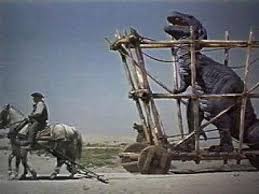

Valley of Gwangi 1969
Certainly a modern  re-imagining of the dinosaur cowboy crossover would be a lot of fun-  it could not be any worse than the recent Cowboys v Aliens. And perhaps the coupling of dinosaurs and cowboys is more appropriate, ecologically speaking, than is apparent at first glance...

The American cowboy mythos, perpetuated as a truly "Americana" cultural hero, is a bit of a bastard of spanish vaquero culture and American westward frontiersmen. It is a construct maintained in the hearts and minds of Americans through iconographic films, a fetishization of cowboy style, and cultural inertia. But at the heart of cowboy celebration and appropriation is a weak link- the cowboys namesake itself, cows or Bos taurus- the domestic cattle. You see trying to run cattle in the arid west is, ecologically speaking, trying to fit the proverbial square peg into a round hole. They just don't fit.


Ask yourself this- which state runs the most cattle? If you answered Texas you are right- but this state is misleading for Texas is the largest state in the lower 48. Check out this if you wanna see the real breakdown of where Americas cattle are at. Although not the most up to date (2007) this chart does reveal some interesting trends. What you really want to look at is the number of beef cattle per square mile of farm. What you see here is that only three western states break into the top twenty for beef cattle per square mile of farm, Nebraska (16), Nevada (18) and Texas (19). Western states that have a long tradition of free range cattle (often on public lands) such as Arizona (48), New Mexico (43), Montana (27) and Oregon (21) score even lower. But what really should jump out at you are the states that lead in beef cattle per square mile. The top ten in order are Tennessee, Florida, Virginia, Kentucky, Hawaii, Alabama, Missouri, Arkansas, Louisiana, and Oklahoma. What you should notice is that for the top ten most productive cattle producing lands- 9 of them are southern states but all of them are wet!!!
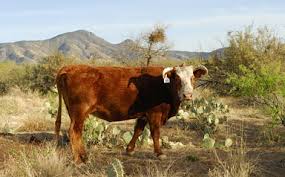

Cattle in the desert? You are doing it wrong!!!

It may be a little discomforting to western states and to our cherished notion of cattle belonging in the arid west but the data do not lie. Cattle do not thrive in the arid west but do marvelously in the humid south. How to explain this data? We need to look at the species from which cattle are descended, the now extinct Auroch cattle- Bos primigenius.


The last wild auroch died in floodplain forests like the one to the left during the 18th century. As you can see this habitat is dramatically different from the Arizona desert scrub of the cattle in the picture above. How did these bovines behave? By all historical accounts they were more agile, taller, more aggressive, and possibly more stealthy than their domesticated descendants. I would not want to attempt cow tipping one of these brutes.

Auroch
Tracking the wild cattle of Sapelo Island may give us our best glimpse of how Auroch behaved and their preferred habitat. On this Georgia Barrier Island wild cattle have colonized the island and, like feral pigs, reverted back to the ways of their wild ancestors.  Paleontologist/ichnologist (footprints) Tony Martin paints a picture of a stealthy, cryptic, salt marsh foraging beast that is rarely seen and utilizes both maritime forest and salt marsh habitats fully. When encountered on open ground these cattle quietly slip back into the cover of the forest. This image of cattle repatriated to their rightful habitat contrasts sharply with our traditional view of cattle as slow, insipid, docile and dumb. Instead they are robust, vibrant Pleistocene survivors most at home in wet/well covered habitats- not open arid plains. Below is a picture of a lone male bull on Sapelo Island that captures the wild nature of these cattle.
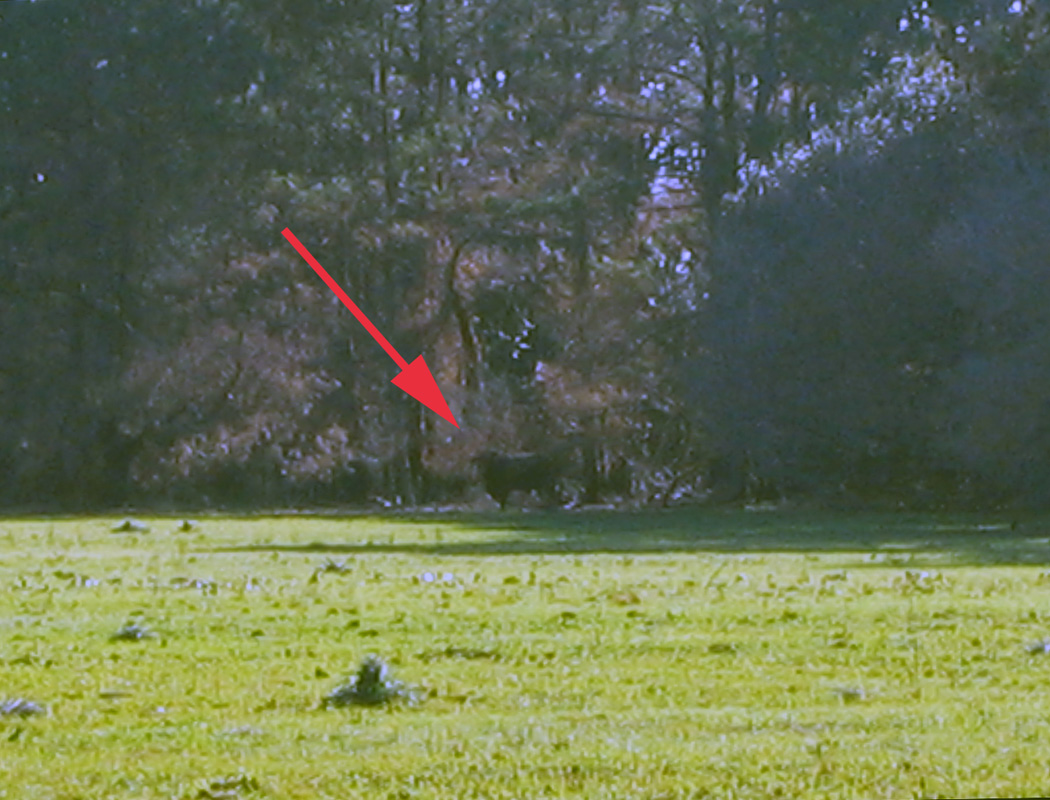
(c) Anthony Martin


Of course when you put cattle on arid lands they do survive- but at what costs to the land?

Well one could go on and on on this tangent but   I would rather outsource my arguments. Look at this photoessay on the degradation of riparian habitats, loss of biodiversity and ultimately loss of cattle to drought when cattle are raised in arid climates. If you want to go further read Welfare Ranching. If you come across some pseudo-scientific arguments that heavy grazing is good for the land, usually it goes under the name of holistic management don't buy it. Cattle raised on arid lands are not suitable replacements for buffalo because cattle are not mobile like buffalo. Buffalo, or bison, are constantly on the move and do not overgraze- ideally they are also in the presence of wolves and bears which keep 'em moving as well. And in southwestern deserts bison did not occur in any great numbers or were absent entirely.
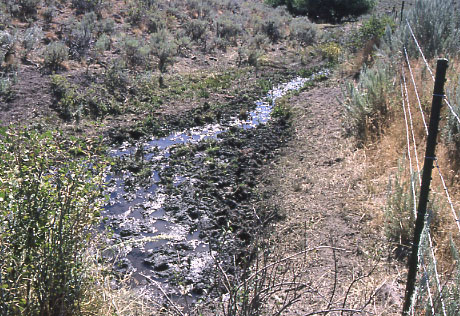
Redband trout stream degraded by cattle. Magpie creek ID

Left is private land right is public overgrazed land Sequoia Nat Park CA
It is a little ironic that many of the traits we admire in "cowboy mythos" persona stem from the very difficult conditions of raising cattle in arid lands. Perseverance, hard work, grit determination and gumption would be traits absolutely necessary when trying to raise a water dependent domesticate in an arid land full of predators, droughts, and generally hostile conditions. Right now the wolf and grizzly bear are making inroads on lands they were extirpated from. Americans must decide if they want healthy intact ecosystems with top predators or repeat our mistakes if they want to maintain the cherished cowboy mythos which is more and more apparent as a mirage in the desert.


Oh yeah and what was that I mentioned earlier about dinosaurs being better suited ecologically for ranching by cowboys on arid lands than cattle? Well like reptiles and birds dinosaurs produced uric acid    which is less water soluble than the urine which mammals produce. This does not dehydrate organisms who produce uric acid as readily as those who produce urine. Essentially this is why you can go for a hike on a relatively warm day in an arid area and see plenty of reptiles and birds- but all the mammals are outta sight. Dinosaurs were essentially preadapted to desert/arid conditions. Having to drink less than large mammals large dinosaurs would not have had to make as many trips to drink and therefore had less of an impact on riparian vegetation communities. Another argument of mine in support of my theory that dino herbivores were less harsh on vegetative communities than herbivorous mammals...but I digress.

What type of dinosaur would be the ideal type for ranching in the arid west? Well it would be able to survive on poor quality fodder, reproduce quickly, have an efficient food to flesh turnover, not have sharp feet that erode thin soils, and be able to either defend itself or escape from large predators. And this dinosaur still exists- its called an ostrich.


Cheers!!!


Friday, October 12, 2012

"Global Weirding" in the Cretaceous

Geophysical fluids dynamic model of equatorial current showing persistent eddies (c)Earth Sci-Rev 2012 Oct


Well here in 'Merica we are in the midst of the great presidential race of Mitt vs Obama 2012, which of course will decide the fate of this country and therefore the world at large. Once again the country is divided on numerous issues; genital politics- who gets to marry who and what women can do with their fetuses; the role of big government vs small government; and how to recapture a robust middle class. However it has not escaped the notice of some that the issue of climate warming or "climate weirding" (which I prefer) has elicited nary a mention from either side. Perhaps both sides have been advised to not mention such a pressing issue- to either outright deny its existence or promise to curb it may be akin to political suicide at this pass. Even the Obama advisors who helped catapult Obama into presidency in '08 largely on a platform of green job growth may now realize all to well that any remedy we can muster to soothe our climate gods is akin to putting a bandaid on an amputated leg. It's too late.

(c) Mike Luckovich Atlanta Journal Constitution


This is for shame because if North America continues with drought conditions it will not be long some think before this country starts to see the food shortages and hence food riots that other countries are already experiencing. And when people are rioting on the streets for food or water the issues of who gets to marry who and even who gets to hire who will fall by the wayside. We will all be too hungry to really care.

Algerian food riots 2008. Guardina.co.uk (c)


Of course I could be wrong, we can all hope. But climate change, often dramatic, in the context of geological time is the rule rather than the exception.

A new paper written by William W. Hay and Sascha Floegel, New thoughts about the cretaceous climates and oceans, synthesizes much of the current thought regarding this critical juncture in earth's history.

Abstract

Several new discoveries suggest that the climate of the Cretaceous may have been more different from that of today than has been previously supposed. Detailed maps of climate sensitive fossils and sediments compiled by Nicolai Chumakov and his colleagues in Russia indicate widespread aridity in the equatorial region during the Early Cretaceous. The very warm ocean temperatures postulated for the Mid-Cretaceous by some authors would likely have resulted in unacceptable heat stress for land plants at those latitudes, however, and may be flawed.
Seasonal reversals of the atmospheric pressure systems in the Polar Regions are an oversimplification. However, seasonal pressure difference between 30° and 60° latitude become quite pronounced, being more than 25 hPa in winter and less than 10 hPa in summer. This results in inconstant winds, affecting the development of the gyre-limiting frontal systems that control modern ocean circulation. The idea of Hasegawa et al. (2011) who suggest a drastic reduction in the size of the Hadley cells during the warm Cretaceous greenhouse is supported by several numerical climate simulations. Rapid contraction of the Hadley cell such that its sinking dry air occurs at 15° N latitude rather than 30° N is proposed to occur at a threshold of 1,000 ppmv CO2 in the atmosphere. This change will probably be reached in the next century.

Now longtime readers of da' Salad should recall my first paleo-myth where I discussed the myth of the enduring, unchanging tropical rain forest. It now appears that not only is the tropical equator belt not a safe womb of biological diversity, it is actually a crucible of evolution. And the high extinction and diversification rates for equatorial regions do fall in line with this model. 

The distribution of modern deserts is strongly influenced by the Hadley cell and it is no coincidence that most major deserts occur at about 30 degrees north or south of the equator, also known as the subtropical convergence belt. However work by Hasegawa shows that this zone shifted poleward during the Cretaceous thermal maxim to between 31 and 41 degrees north of the equator followed by a rapid retraction equatorward to between 22 and 30 degrees north of equator during the mid Cretaceous. What Hasegawa and the authors in the above study suggest to be the threshold for this equatorward retraction of the subtropical convergence is CO2 levels above 1,000 ppmv a level we are projected to reach by the next century. Scary stuff. Imagine the tropical latitudes, where a good portion of humanity lives, inexorably transformed into desert wastelands. More temperate latitude countries would essentially be crushed by the burden of either importing food into these areas, which is already happening to an extent, or finding ways to either thwart or absorb these populations looking for food. Scary stuff.

Well let's shift gears from environmental doomsday scenarios into ideas about what this on and off again Mesozoic arid belt meant biogeographically for dinosaurs. plants and other organisms. What questions does it raise? What should we be looking for? What were these arid equatorial Mesozoic ecosystems like? More to come....


Perinencia


Sunday, October 7, 2012

Planet Parasite II: Battles in the North

In the first episode of Planet Parasite we looked at how, despite their overwhelming majority in species count compared to free living organisms, parasites have been traditionally overlooked as important ecological players. To counter this myth, which may partially stem from an emotional hatred of parasites, I gave an example of the parasite influenced food web of coastal southern California salt marshes. I should highlight that the type of influence the killifish fluke exerted on that ecosystem is not exceptional- and upon inspection many, if not all, food webs will undoubtedly show some level of parasite influence. Far from being merely a nuisance, parasites dramatically dictate the movements of certain species and thus influence how that species interacts with other organisms in their environment. It is reasonable to assume that all wild species are adapted to cope and coexist with some level of parasite load. But what may be a little shocking is that in certain circumstances, usually during periods of environmental instability, the equilibrium of sustainable parasite loads can be tipped highly in favor of the parasite. And ultimately in such circumstances parasites act as "micropredators" consuming their host to the point of death. In this manner parasites exert a strong "top down" influence in their ecological community comparable, or sometimes exceeding, the top down influence of predators which has been a recurring riff here at da' salad.

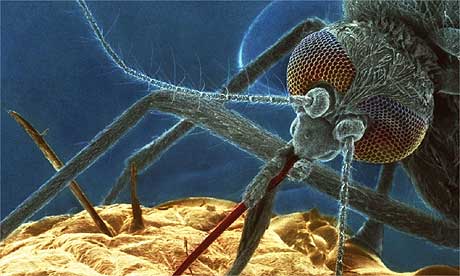
female Anopheles mosquito

Barring a thermonuclear crisis between Israel and Iran, 2012 may well go down as the year of the parasite. West Nile Virus put up strong numbers throughout the country and, only detected in 1999, was reported in 48 states and is here stay in the US. Bed bugs are becoming epidemic. Its also been a banner year for fleas and ticks, if you have pets you probably have noticed a higher than usual amount of parasite load on woofie and meow-meow this year. Simply put global warming is hastening the spread and proliferation of many parasites- particularly in the temperate to arctic latitudes. In the tropics, long a miasma of some of our most feared parasites and their diseases, its basically business as usual for parasites. But in areas that are having their winters cut short and summers extended parasitic bugs are waking up earlier and breeding more often throughout the year. And because these critters have such a high turnover rate and rapidity of generations compared to their host species- we can safely assume that they are evolving more quickly and adapting more rapidly to changing climatic schemes across the globe than their host. The parasite always wins.

A wealth of anecdotal reports is streaming in (see links in Pertinencia below) suggesting that shorter, warmer winters and longer and hotter summers are hastening tick outbreaks in moose populations- especially in the southern limits of the moose range. While many are crying foul and that these reports amount to nothing more than global warming propaganda, many of these reports are coming in from seasoned hunters/outdoorsmen- not your usual suspects when it come to environmental hyperbole. What they are finding paints a distressing and gruesome picture of an ecosystem in collapse.

Jerrold Masson (l) and father James Masson show off some bear chewed antlers. Jerrold and his father claim to have encountered unusually high numbers of tick killed moose in Maine

"These are not winter kill" states lifelong outdoorsmen Jerrold Mason of Maine."Of the typical winter kill animals like moose it gets sick, it stands in a small area and basically you find 400 moose droppings and a dead moose in the middle of it." Freshly thawed out following the winter these moose are still covered in ticks and show no sign of predator kill or even scavenging, "The coyotes wouldn't eat them; the bears wouldn't eat them." Dubbing the dead adult moose and calves as "tick kills" Jerrod and his father and friends claim to have counted up to 60 dead moose where in the past they would normally find at most five winter killed moose.

The following pictures are from the hunters forum menoutdoors.com (lolzy name I know) http://www.menoutdoors.com/forums/showthread.php?t=9082  where a family came upon a moose in Nebraska so weakened from tick blood loss that they could readily approach the ailing herbivore- he even let his kids pet it (ewwww). The moose died the next day.


So what is it about the moose and this particular tick species- the winter tick- that allows these infestations to get so bad? Well here is a good write up on the intricate relationship between winter tick and moose. It turns out the name winter tick is an apt one because peak infestation and stress on the moose occurs in late winter/early spring during the months of March, April and early May. During this time the female ticks are schlurping up loads of blood in prep for egg laying (up to 100,000 winter ticks have been documented on a moose). The female ticks, after mating with smaller males, will drop off of the moose around this time and lay eggs in the leaf litter. This is a critical point in the cycle. If the snow pack is deep at this time of year the female ticks may die in the snow before they can safely lay their eggs- thus diminishing the amount of tick offspring that year, But if the snow is light or nonexistent then large amounts of winter tick are able to successfully lay eggs which ultimately lead to higher, and sometimes lethal, tick loads for the moose that season. Not enough late snow is bad news for moose pretty much.


Now just when you thought it was looking pretty grim for moose things appear to be getting worse for the largest cervid in the world. In addition to winter ticks, moose are now facing exotic lungworms from Europe that may represent the proverbial "nail in the coffin" for many moose populations.

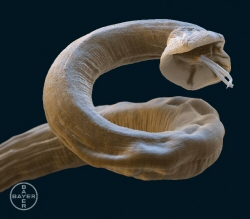
Lungworm

Well, that's enough grim news for now- I usually have a high threshold for this type of stuff but even I am getting a little bummed about the prospects of moose joining polar bears as potentially climate induced casualties of the anthropocene.

Coming up Battles in the North continued: Caribou and Mosquito

Infant displaying instinctive fear of Parasite Hilton


Pertinencia

Death in the Woods

Global warming threatens wolves moose. science daily

Is Global Warming Nurturing Parasites?

Woodsmen, butchers say Maine moose, deer crawling with ticks

University of Maine tackles issue of lungworm in Moose

Tuesday, October 2, 2012

Planet Parasite

Tick before and after feeding

Few things remind can remind you that you are part of the food chain in a more disturbing manner than  the site of a tick crawling up your leg, or, worse yet- the site of one of those arachnids with its head already burrowed into your epidermis. External parasites are one thing, we have at least some control over our exposure to them but right now as you read the inside of your body is home to more organisms than you might care to know about. It is no surprise that public sentiment for parasites of all flavors does not run high. Indeed Nature magazine of all publications recently ran a news article suggesting that if all the mosquitoes in the world went extinct global ecosystems would carry on with barely a hiccup. The article, more of an opinion piece than an actual scientific paper, was roundly criticized on several levels (read the comments). First off you would lose numerous freshwater fish species that depend on mosquito larvae, migratory birds that depend on arctic mosquitoes during the summer  would be hard hit, and many flower species actually depend on mosquitoes as pollinators. The loss of more than 3000 mosquito species may in fact be more dire and catastrophic than one might imagine. The nature article does provide a service to our (mis)understanding of community ecology because it underscores a pervasive ecological bias towards parasites. Generally speaking the role of parasites in ecological studies has been historically downplayed, dismissed, or outright ignored. Why the bias? Well, most importantly imo, they are hated- we would rather imagine a world without them. Secondly they are generally small- how could such small, cryptic species be important? Thirdly their lifestyles are often complex and their effect on ecosystems may be equally complex and throw a monkey wrench into the conservative ecological dogma of herbivore eats plant predator eats herbivore blah blah.

So what are the ecological effects of parasites?

Well, you might want to read this here but let's just look at some numbers.

If you were a biologist visiting earth you might be astonished at the simple numbers of parasitic species on this planet. Parasites, by some estimates, outnumber free living species 4 to 1. But this may be an underestimate, especially when you consider that parasites have parasites. Regardless parasitism is the dominant mode of life on this planet and that alien biologist would not be overstating the case by referring to earth as Planet Parasite.

By their simple numerical abundance we should expect parasites to have profound ecological implications.

And parasites are not simply freewheelin' along for the ride on lifes' movable buffet but recent studies suggest that they are often secret architects, planners, and commissionaires of their respective ecological communities.

Studies into the coastal marsh community highlight the profound effect of parasites on the organisms that live there. Euhaplorchis californiensis navigates a lifecycle through three separate hosts- profoundly affecting the fortunes of each along the way. Life for these flukes begins in a pile of bird droppings.


These droppings are consumed by grazing horn snails. The fluke then effectively castrates the poor snails so that all of the snails resources go towards the fluke at which numerous free swimming flukes are produced. These "eunuch" snails, on a side note, now compete with reproductively capable members of their own species and actually cut snail populations in half.

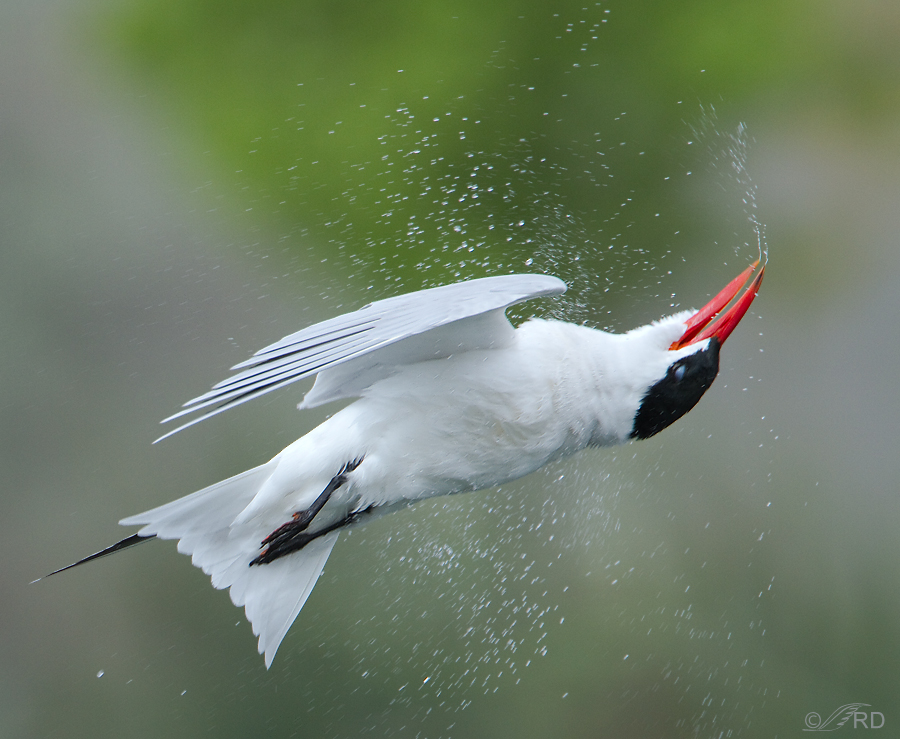
These free swimming little buggas, once free from the snails, next target the gills of the California Killifish (Fundulus parvipinnis)- a common coastal species from Baja CA to the Bay area. The flukes then congregate around the brain of the fish. This results in some aberrant behavior on the part of the fish- who now flash and skimmer along the surface four times as much as uninfected fish. That parasite induced behavior results in the fish being 30X more likely to be nabbed by a fish eating bird than an uninfected fish. And now the parasite is in its final home- a bird- where it feeds and expels numerous eggs in the bird feces. One may imagine that these predatory birds would be more picky about eating potentially parasitized fish- but for them the benefits out weight the risks. Simply put, if all the fish were as difficult to catch as the healthy ones the fish eating birds could not exist in such abundance.

Caspian Tern (c) Ron Dudley

Yes we truly live in a parasite mediated world. Planet Parasite. Remember you can't call yourself a nature lover if you don't have some love for parasites. If you hate parasites you automatically hate the vast majority of life that lives and has lived on this planet.

best parasite movie ever Brain Damage

Coming Up Planet Parasite II: Battles in the North

Pertinencia

Nature Editorial: A World Without Mosquitoes

Ecological Consequences of Parasitism a Review

Lafferty, KD, RF Heckinger, JC Shaw, KL Whitney and AM Kuris. 2006. Food webs and parasites in a salt marsh ecosystem. In Disease Ecology: community structure and pathogen dynamics. Oxford Un Press. pdf


Support me on Patreon.
Like antediluvian salad on facebook.
Watch me on Deviantart @NashD1.Subscribe to my youtube channel Duane Nash.


Thursday, September 27, 2012

Paleo-Myth Number 6: Giant Insect Size Through Time


Ok so its been a little bit since I put up a paleo-myth since my last one here where I covered the issue of dinosaur competitive exclusion of mammals during the Mesozoic ( Paleo Myth 10, 9, and 8 btw). In it I argued that it was a trifecta of immature dinosaurs, terrestrial crocodiles, and sphenodonts putting ecological pressure on mammals. Like that post I will again be dealing with size constraint on a clade of organisms except this time it will be insects.

In the above picture we see a gargantuan mosquito filling up on Will Ferrel's blood in what I thought was a genuinely funny movie Land Before Time. While the giant mosquito was the least of the films scientific oversights the idea of giant bugs coexisting with dinosaurs is still intertwined in many people's minds. But this is a bit of an error because the hey-day of giant exists was the Carboniferous (300mya) period so dinosaurs, who arrived mid Triassic (230mya), missed guys like Meganeura by about 70 million years. In other words, dinosaurs were separated by giant insects for a span of time longer than what we are now separated from non-avian dinosaurs (65mya). So depiction like the one above, or the nightmarish arthropods of the King Kong remake below are erroneous.


So why such big bugs back in the coal era of the Carboniferous? Well the prevailing view is that higher oxygen concentration in the atmosphere (35% vs 21%) allowed insects, as well as other arthropods like arachnids and millipedes, to grow larger than today owing to all these groups having relatively inefficient repiratory schemes (spiracles, book lungs).  An insect essentially lets air "soak" into it from holes in the sides of its body. As an organisms surface area increases the volume increases at a far greater rate. So eventually an insect reaches a size where it is limited by the amount of surface area it needs to respirate its internal volume. Oxygen becomes limiting to insect size. Other arthropods, spiders for instance, are less constrained by oxygen but still run into problems from their exoskeleton breaking down in strength with increasing size. If insects or other arthropods found a way to actively respire they could at least get lobster size on land before the exoskeleton became limiting, regardless of oxygen concentration. Overall an abiotic factor, oxygen concentration, appears to be the limiting factor preventing hawk sized dragonflies from buzzing the Kardashians. Or is it?


Meganeura, crow sized dragonfly of Carboniferous


In a recent study from UCSC (go Slugs) researchers tracked the size of insect wings with oxygen concentrations throughout earth history. What they found was that insect size correlated nicely with oxygen concentration until about 150mya. They found that insect size dropped during this time period, despite a worldwide increase in oxygen levels. Why were the bugs not as big as they could be? The authors argue it was the worldwide emergence of sophisticated aerial theropods (i.e. "birds") that put predatory pressure on flying insects to select maneuverability over size (all flying organisms lose agility with increasing size).


Large flighted insects would both be easier to catch and also offer a greater caloric food reward than small ones for birds- they were optimal prey. The researches also found another dip in insect size later in the Cretaceous, possibly due to increasing sophistication of bird flight and the emergence of bats. They found no correlation between pterosaur emergence and insect size. perhaps bolstering the argument that pterosaurs were predominantly terrestrial foragers and not as well designed for aerial "hawking" as birds are.


Interestingly modern flying insects are not as large as they could be- and we can thank birds for that.


Pertinencia

Mechanisms of Maneuverability

Harison, Jon. Atmospheric oxygen level and the evolution of insect size. Proceedings of the Royal Society Biological Sciences. March 10, 2010.
http://rspb.royalsocietypublishing.org/content/early/2010/03/04/rspb.2010.0001.full

Reign of the Giant Insects Ended With the Birds

Abstract


Support me on Patreon.
Like antediluvian salad on facebook.
Watch me on Deviantart @NashD1.Subscribe to my youtube channel Duane Nash.


Related Posts Plugin for WordPress, Blogger...