Showing posts with label mushrooms. Show all posts

Tuesday, May 21, 2013

Rot n' Roll in the Mesozoic Muck

Regular readers of this blog ( all 5 of ya') will have picked up on the perseveration I have evinced on several of my recent posts with all things rotting, decaying and dead. Yes detritus, detritivory and detrital food chains have been on my mind as of late. In a manner that parallels the "invisible hand" of parasites in food chains, the importance of detritus and all that subsist on it is too large to be ignored in any consideration of ecological concerns, past and present.

Let's review a couple of key concepts that prove useful for this post. Decomposers- bacteria/fungi- do the actual breaking down of the key nutrients, organic and inorganic, from dead stuff. They chemically liberate the trace elements, proteins. lipids, starches, and carbs that in turn are more easily swallowed up by themselves or other organisms. Detritivores actually ingest internally discrete chunks of detritus. In doing so they are not only ingesting the dead material- but also consuming the decomposers already subsisting on it. And this is an important concept. By the time an earthworm gets to a leaf on the forest floor it has already been colonized by several stages of microbes who have themselves digested the lion's share of sugars, proteins and lipids. But the decayed leaf is not nutritionally void for the earthworm- it gets benefits from eating spore and bodies of the bacteria/fungi themselves which are full of lipids and proteins. Now it is true that many detritivores target the cellulose/lignin in plant stuff- but even here bacteria/protozoans are needed to digest it and are found in the consumers digestive system. But the relationship between decomposers and detritivores is not a one way street- detritivores "shred" material creating more surface area for microbial decomposers to take hold. Detritivores also spread microbes through faecal pellets. So both decomposers and detritivores work hand in hand for maximal nutrient cycling.

If you are an avid gardener or just like dirt you are probably well aware of the "brown revolution" and how intricate and diverse and how alive soil biota is. Check out this cool pic below.

Although you can extend out the putative detrital food chain illustrated above to include some larger critters- loads of birds, reptiles, amphibians- depend heavily on protein extracted from one or more links in the pic above- by and large it is dominated by smaller critters. In contract to the trophic cascades observed when top predators are removed from live plant/herbivore based trophic systems if you get rid of robins, moles and armadillos detrital based ecosystems would likely keep on going with scarcely a hiccup. But although large animals do not figure prominently in detrital food chains,
Purple Snout Mite (c) USD
that is not to imply that there are no monsters in your soil. Predatory mites have some pretty grim looking predatory tackle. Imagine that guy on the left spearing some tasty nematodes in your lawn. And some types of earthworms in Australia get surprisingly large in size. But by and large any investigation into detrital ecosystems is benefited by the use of microscopy. But what if a large animal, say on the order of several tonnes in weight "hijacked" detrital food chains and inserted itself in some link in the chain usually reserved for smaller critters?

It might sound strange and incongruous with what is seen in modern ecosystems but let me make an analogy with baleen whales. Baleen whales, including the largest animals ever evolved, are famous for subsisting on some of the more smaller critters of the ocean. Rorquals actually go after discrete chunks of schooling baitfish/krill. Their "lunge feeding" technique, which has been described as the 'single largest biomechanical action in nature' is best seen as a type of active predation. Something like a bowhead whale shows a more passive processing of large volumes of water. But I am drifting a bit here 'scuse me- the point here is that baleen whales take up ecological space that might otherwise be occupied by small fish, sea birds, squid etc etc.

So if you are following my torturous logic you probably see where I am going with this- were there ever any terrestrial mega-detritivores in earth history that hijacked ecological space traditionally occupied by less robust critters? Something like a giant walking compost bin? Interestingly there is a bit of evidence pointing to dinosaurs occasionally enjoying a bit of detritus.

In 2007 Karen Chin wrote a paper The Paleobiological Implications of Herbivorous Dinosaur Coprolites from Two Medicine Formation of Montana: Why Eat Wood? which addresses some unusual dino shit. The dino dung in question, (there are several), is unusual for being composed mainly of woody conifer fragments. That the conifer wood was already in a state of decay is evinced by the evidence of fungi degradation. And Chin makes the assertion that the dinosaur was seeking to exploit the nutritive benefits from the fungi and possibly other critters in the decaying wood- rather
Nature of Robertson.blogspot
than seeking the nutritionally bereft wood itself. Now this is an interesting and valid interpretation in my opinion. It does take us away from our comfortable view of herbivorous dinos being  "proper" vegetarians. And, as Chin also asserts, in a world largely devoid of easily digestible angiosperms (esp grasses) dinosaur herbivores may have routinely sought out detrital resources to augment their diets nutritionally. Cool and weird. Keep in mind that the modern habitats with the largest amount of biomass on earth are not the tropical rainforests- but cooler termperate rainforests. (Insert discussion on carbon balance, plant respiration, temperatures). And I don't think it is a stretch to suggest that the biomass of many of the more high latitude Mesozoic ecosystems also was also tremendous with ample  opportunities for detritivory (seasonal or full time?) for the herbivorous dinos that lived there.
But before we get swept up with images of armadas of ornithischians falling upon decaying Mesozoic timber lets consider another possibility that I want to put forth...

It should not go without notice that the dino poop in question in the paper is most certainly from Maisaura peeblesorum. The Two Medicine formation is dominated by the famed "Good Mother Lizard" and both Maisaura eggshell and bones are found at this Late Cretaceous dino latrine. Now nesting colonies of large herbivorous dinos must have been special and weird places, we don't really have a proper modern analogue for what these areas were like. If extended parental care was practiced it can well be imagined that the local flora took a profound hit from possibly thousands of megaherbivores in a relatively small area. In this scenario the hadrosaurs were eating decaying wood because everything else in the vicinity had already been consumed.

But there is another possibility for what was going on here and this one really stretches the weirdness factor and involves some unabashed speculation on my part (but that has never stopped me before): Maisaura peeblesorum was a fungi farmer.

Consider that leaf-cutter ants are often the most important herbivores in many Central/South American ecosystems. But since the ants are not exactly eating the leaves they are cutting, but instead mincing them up for their fungal gardens, they are better described as mycophagists (fungi eaters)
rather than classic herbivores. In a sense they let the fungi digest the plant and the ants consume the more easily digestible fungi.

So what I am I suggesting here- that Maisaura built huge underground fungi colonies? No of course not. What I am suggesting goes like this: We know that Maisaura showed strong site fidelity for nesting colonies and that these colonies may have been exceptionally large. Likely they returned during a specific time of year, most likely coincident with the rainy season and abundant plant growth. Based on crushed eggshells and the preservation of infants several months old in the nest it appears that the nestlings hung out around the nest for some time and were acquiring nutritious food either by foraging or some type of parental provisioning or a combination of the two. From faecal remains we can surmise that adults were consuming fungi-degraded wood and depositing faeeces adjacent to nesting areas. At this point is where the speculation comes in; Maisaura adults were targeting fungi infected wood, most likely of a specific species of fungi, in order to inoculate their own faeces with the spore of the fungi. They would then deposit said faeces in proximity to the nesting colony. The hatchling Maisaura which were somewhat precocial would then have a regular food supply delivered in proximity to the safety of their nest. The faeces would provide an ideal substrate for fruiting bodies (mushrooms) to form, protein rich insects/inverts would be attracted, and the faeces themselves would provide a larder of beneficial digestive microbes that the hatchlings would inoculate themselves with. This provisioning may well have lasted several
Paneolus antillarum on Elephant dung
months as the hatchlings grew in the relative safety of the colony. Although not exactly mother's milk, the faeces along with the insects and fungi growing onto and in them would have been generally a better more protein rich food supply (fungi offer a more complete protein profile than plants) than whatever the hatchling would have foraged for on their own or even regurgitated plant material from the parent- although there is no ruling that out as an additional source of food. But keep in mind that the size of the dino poops reported by Chin was up to 7 liters- a good sized source of food for those cute little  hatchlings.

And if you think coprophagy is weird and unusual behavior- go investigate further- its prabably easier to compile a list of the animals that don't do it rather than those that do, especially among herbivores.

Cute Bunny Chills and Eats Poop.

Cheers!


Support me on Patreon.
Like antediluvian salad on facebook.
Watch me on Deviantart @NashD1.Subscribe to my youtube channel Duane Nash.


Tuesday, November 20, 2012

Chicken Fat in the Fall


What does the Fall mean to you? Cozy evenings by the fireplace? Chamomile tea and that extra hour of sleep from daylight savings? A pervading sense of the rhythms of life winding down? Turkey, flu shots, and football americana?

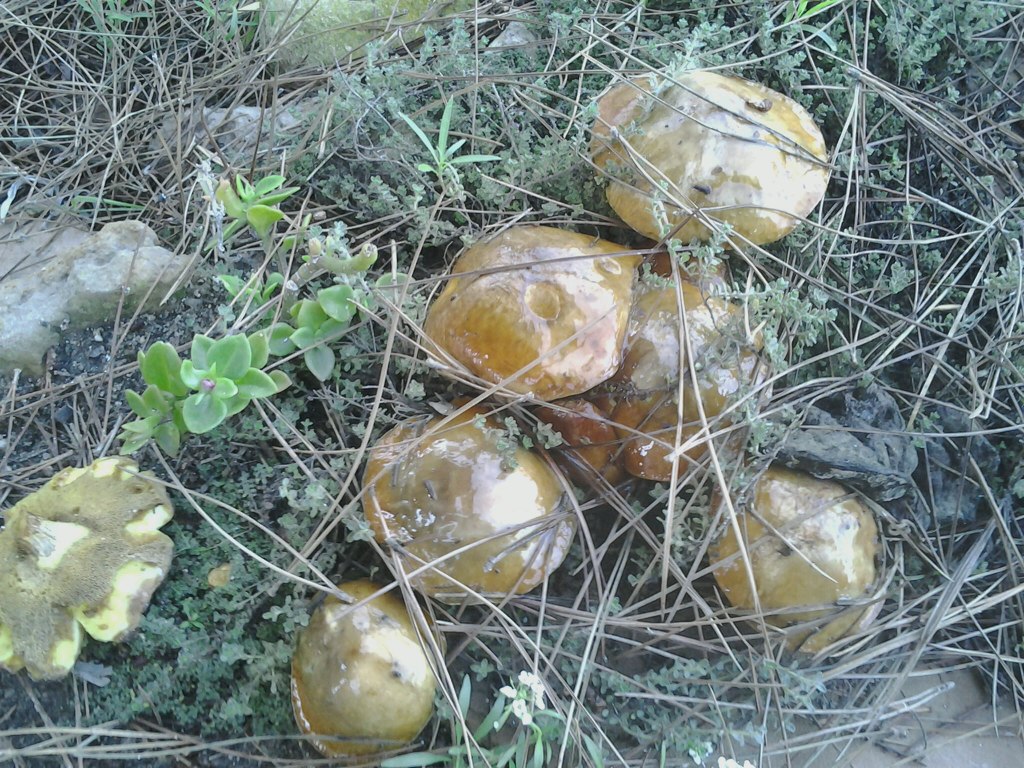
Well for me Fall in my neck of the woods is the time for mushroom foraging. I am constantly bewildered by the strange appearance and bewildering diversity of mushrooms that crop up even in the relatively semidesert conditions of southern California. This year we got a new type that I have not seen before cropping up amidst the shaded flagstone in our backyard.

Now I am barely a novice at mushroom identification but a quick perusal of the interwebz and I am fairly confident that this is the chicken fat mushroom aka American slipperyjack, scientific name of Suillus americanus on the East coast which is most likely synonymous with what is seen in Asia and western North America Suillus sibericus.


The most obvious feature of this 'shroom is slimy appearance of the cap, which is actually an interwoven layer of gelatinous hyphae and the beautiful yellow colors morphing into browns on the stem and cap. Some claim touching this results in an irritation similar to poison oak although I seem immune. It lacks gills and has distinctive pores. As you can see in the pic above some type of critter has been nibbling on these structures, likely slugs or snails although I have yet to catch this critter in the act. As far as human consumption is concerned I read that although it is edible, reviews are mixed. It supposedly sometimes has a mild lemony flavor but that slimy texture does not go away with cooking and is recommended as a spread. Several reports suggest that consumption leads to frequent bouts of bathroom usage. Needless to say I have not tried to eat this 'shroom because I am not experienced enough, nor do I really like slimy foods and I am a little scared of the purported intestinal distress it invokes.


Interestingly I have read that this species forms specific mycorrhizal associations with various species of pines (Pinus). As you can see from the pic above the chicken fat is growing among thyme and although  we have Italian Stone Pine (Pinus pinea) trees growing nearby, the mushrooms are not really in the root zone of these pines, living on a raised flagstone patio which was built several years ago.

Italian Stone Pine forest. Costa de Luz Spain. wiki


*Amendment November 21. Since I published this post additional chicken fats have came up closer to the base of the Italian Stone Pines suggesting that they are indeed in a mycorrhizal association with the pines. Most likely is that the roots of the pine have grown up into and around the flagstone patio- since it receives water throughout the year for the groundcover growing between the flagstones. 


Cheers!!!


Support me on Patreon.
Like antediluvian salad on facebook.
Watch me on Deviantart @NashD1.Subscribe to my youtube channel Duane Nash.


Related Posts Plugin for WordPress, Blogger...