Showing posts with label deep scattering layer. Show all posts

Sunday, December 7, 2014

Plesiosaur Machinations I: Introducing the Plesiosaur Phalanx Attack

Machination: a scheming or crafty action or artful design intended to accomplish some usually evil end.

Ok no talk of that movie, or Spinosaurus cuz it gets everyone including myself into a tizzy - no let's talk about something nice and non-controversial: plesiosaur feeding ecology. That is a pretty hum-drum topic no?

Of course your sarcasm detector should be buzzing and plesiosaur (for our purposes here just assume I am referring to the long necked variety when I say plesiosaur so I don't have to say "plesiosauromorph plesiosaurs" every time, ok) feeding ecology is just one of those topics in paleontology that continues to stifle us. And with such a strange and unparalleled morphology there are no shortage of foraging techniques, and otherwise, that have been suggest for dat neck. Adam S. Smith has compiled a good overview of many of these, check it out at your one stop shop for all things plesiosaurian: The Plesiosaur Directory. And hey, it included my twist feeding idea (not just for ammonites though but for any carcass, scavenged or otherwise, too large to swallow), among others. Now in this post I am not going to focus on twist feeding but actually incorporate that style of foraging - with several others listed there - into a more holistic interpretation of plesiosaur feeding ecology.

Before we begin - some qualifiers. Plesiosaurs were not as "samey" as often portrayed. Some were possibly straining small food particles out of the water column or substrate; some were equipped with especially heavy bones that may have allowed specialization on bottom foraging; some had extremely long, almost comical necks and some had necks that were rather conservative. I would argue further that what we are really seeing is a spectrum of species ranging from the plesiosauromorph bauplan to the pliosauromorph bauplan. Guys like Rhomaleosaurus (pictured below) traditionally called a pliosaur, actually fit nicely between the two extremes. Although big headed, it also has a long neck, especially by todays standards. So keep in mind that some species may have varied quite a bit from the picture I am going to paint depending on neck, teeth, skull etc. etc.

Rhomaleosaurus. A "pliosaur" yes, but still pretty "necky". wiki. Niki Odolphie
And in my last post on plesiosaurs - Thus Spoke Zarafasaura (catch my clever literary nod to Nietzsche there) - I discussed an elasmosaurid, Zarafasaura oceanis,  that may have been punching a little bit above it's weight - or at least was showing showing some skull/skeletal adaptations geared towards more rigorous feeding activities beyond the usual "gape limited, small fish only" dogma that dominates plesiosaur feeding ecological interpretations. I mean would you really be confident enough to go for a swim next to this guy? Are you so very sure it was "only a threat to small fish and squid"?

Zarafasaura oceanis
But hold your judgement for now as to whether or not some plesiosaurs were maybe biting into bigger stuff than generally portrayed, hopefully I can sway you later. I want to reiterate and restate a theme I brought up on that post about Zarafasaura which will also be at play in this and future posts on plesiosaurs. And that is, unlike the case with many popular and idiosyncratic prehistoric animals, I am going to argue that the earlier popular reconstructions of plesiosaurs captured their essence a lot more precisely than more current plesiosaur depictions. Now I am not talking about the S-shaped snake like neck here, or lifting the heavy neck swan like out of the water - I am not suggesting those physical feats are possible. I am talking about the portrayal - especially in those early gothic, black and white murals - that speak to a creature, while not immune from predation, was still willing and able to go to toe to toe (err flipper to flipper?) and dish it out against the other bad asses of the seas. Not a creature whose long neck was a liability and and made it a veritable punching bag to other bigger mouthed-stronger jawed creatures of the sea but a pugnacious, dynamic, and extremely well equipped and adapted marine tetrapod that could hold it's own.

In short more like this:

Thomas Hawkins' "Demonic Plesiosaur Battling Other Sea Monsters (Temnodontosaurus) in Eternal Darkness" 

And less like this:

Dmitry Bogdanov. wiki
Now of course you are probably thinking about all the abundant evidence of plesiosaurs being bit due to pliosaur attacks, mosasaurs etc etc., which is true - they did fall prey to other animals. But I want you to focus on the composition of the two paintings. Both feature two plesiosaurs. In the Hawkins rendition we see the plesiosaurs put up a united front against a possible predator while  in the Bogdanov painting we see one plesiosaur getting rag-dolled and bitten in that "oh so vulnerable" neck while his buddy high tails it out of there. Now I am gonna let you muse on that difference and consider why I think the top picture is more accurate and I will come back to plesiosaur defense strategy in a later post. But it should definitely be emphasized that the way prehistoric animals are depicted plays a profound role in how the debate is framed around these animals, both professionally and to more lay audiences. This can not be understated.

Today's post is on foraging strategy. In order to do so I have to put the cart ahead of the horse a bit here. I am assuming a high level of social unity and group foraging in these sauropterygians. I will address why this is a very defensible position to take with these creatures in a later post and I am sure some of you already know why I am making this general assumption. But for now please allow a little bit of "suspension of disbelief" if you are a doubter.

Of course asserting "group foraging" is a veritable land mine in paleo-interpretation. Let me qualify this a bit. I want to draw a distinct line between cooperative hunting emphasizing a high division of labor, foresight, and usually associated with high intelligence - the kind seen in humans, chimps, wolves, and killer whales and a more of "mob" foraging strategy which I favor for plesiosaurs. Like looters in a riot each individual is acting on their own selfish best interests but have learned that their rate of capture increases when moving and foraging together as a group. This method of feeding is well known in various birds, fish, and sharks and I see no reason that plesiosaurs, though likely limited intellectually, could not have fit into this model. Of course if you have been paying attention we are in the midst of a bit of a revolution when it comes to reptilian intellect and social behavior - planning, social strategy, tool use, and dare we say emotion - so the door might still be open for truly cooperative behavior in plesiosaurs. But for now I am going to take the more cautious approach and invoke the "mob - looters in a riot" model.

And to prime you I want to draw your attention to two examples of group foraging that offer much utility here, white pelicans and white-tip reef sharks.


Now the videos, by Jack Polanen (please like, subscribe, and leave a comment not enough views of these awesome clips),  above and below are highly demonstrative of the efficacy of leaderless, opportunistic group foraging of white-tipped reef sharks (Triaenodon obesus). I will forewarn you it gets pretty graphic and violent at the end of the top video but I would encourage you to watch it all the way through. One thing I would hope you pay attention to: it is often not the first shark to find and/or flush a fish out of hiding that gets it, it is the second or third shark that opportunistically grabs the harried fish. This is an important point that will be revisited later. But it becomes obvious that as a whole this style of foraging creates more opportunity and better efficiency than foraging alone.


And now for another video, again via youtube and from an amateur birder/wildlife documentarian  Michael Descamps, which depicts a quite large congregation of American white pelicans (Pelecanus erythrorynchos) group foraging at the Nygren wetlands preserve in Rockton, Illinois. Like the white-tipped reef shark videos above there is so much here to look at and find visually stunning. Amidst the action it is sometimes hard to pick out individual feeding events but Descamps does a good job of slowing down the video at times and narrating the events. He even took the time to note a frog seeking refuge from the feeding swarm. Again not enough views (something this cool should have more views than the "gangnam style" video lolz) so please watch, like, comment, and subscribe to his videos. Link below pic, for some reason blogger will not link direct to this video ?!?

Michael Descamps (c)

Also, on white pelicans check out the video below of a pretty impressive swallowing feet of a quite large fish by a bird at the same locality by Michael Descamps:


And if you are further intrigued by pelicans check out this amazing video below of how Australian pelicans (Pelecanus conspicillatus) utilize the arid interior of Australia. Highly recommended but a little longer.


Ok now that you have brushed up a bit with group foraging techniques among white pelicans and white tip reef sharks (in actuality I could have went further with loads of examples, especially among fish) before we get to the plesiosaur bit one final rejoinder per popular plesiosaur depictions and the constant push/pull of science/art/opinion. Go google plesiosaur pictures. Ok did you do it? Now among the depictions you are looking at how many show the plesiosaur swimming in a horizontal plane? Most if not all of them, right?

Well here I am going to depart from that convention and suggest that, when group foraging in the water column a vertical orientation was the dominant swimming position. By assuming a vertical orientation this would minimize the likelihood of prey detecting plesiosaurs visually and through  pressure waves when attacking from below; and minimize the chance of detection via casting a shadow when approaching from above. The vertically orientated eyes would naturally align to target prey in this position and allow the head maximum chance of getting in biting range without being detected.


And now without further ado and because a picture is worth a thousand words blah, blah, blah: Introducing the Plesiosaur Phalanx Attack!!


Above I depicted a foraging group of Hydrotherosaurus alexandrae from the Maastrichtian of what is now Fresno, California (being a Cali boy gots to rep) but what was then ocean. Much in the way the military phalanx could crush an enemies defense, the plesiosaur phalanx attack offered little recompense to prey in its sight. The plesiosaurs are rising, silently, cryptically, and slowly from the depths and picking off small cephalopods and fish as they move up the water column. If a prey item is detected the plesiosaur begins a slow, stealthy approach. If the first strike fails and the prey evades capture it is not out of the woods yet as the next nearest plesiosaur swoops its neck and head in to snatch it right up. If that second plesiosaur misses and the poor prey item in question manages to evade it there might still be a third plesiosaur attracted to the commotion which targets said prey. Small fish, crustaceans, and cephalopods could likely move quick enough to evade the first and even second strikes - but facing a full phalanx of lunging plesiosaurs they would quickly tire and be snatched up. Again very similar to the situation with the white tip reef sharks I discussed above.  In this manner we can see how the neck of the plesiosaur - while not snake like per se - offers much utility in terms of covering a wide arc lunging ventrally, dorsally, and laterally after available feeding opportunities and leaving prey little chance of escape.
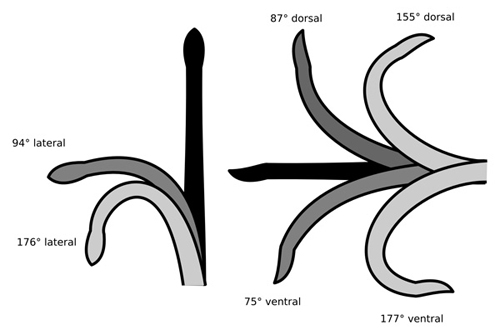
Range of motion as estimated by Zammit et. al. illustrated & used w/permission via Adam S. Smith

The mesopelagic critters I depicted are putative members of the "deep scattering layer", so named because when this biological phenomena was discovered using by sonar during World War II sound would literally bounce, or scatter, off of the dense accumulation of life that congregated at around 300-500 meters below the surface creating essentially a "phantom bottom". Of course every evening, when the largest biological migration on earth occurs - the vertical migration - this deep scattering layer would   disappear as multitudes of creatures seeking refuge in the depth from predators, temperature, and likely other factors rise to the surface at night and then return again in the morning.

So yes, I do imagine that a number of plesiosaurs, especially many elasmosaurids, took advantage of foraging in a phalanx formation on this bountiful and dependable food source. It is worth noting that the famed western interior seaway, a shallow continental ocean usually suggested to be about 100 meters deep, is noted for a sparsity of elasmosaurid plesiosaurs. However once you get off the west coast of North America, where you find deeper, colder and possibly more productive oceans (and a deep scattering layer presumably) - the amount of elasmosaurid plesiosaurs goes up in numbers and diversity. Robert Bakker noted this in his book Dinosaur Heresies on page 430. Furthermore there is a detailed study on evidence of decompression syndrome i.e. "the bends" across sauropterygia. What did they find? Avascualar necrosis was found across all families but significantly lower in cryptoclydids. Best known for the species Cryptoclidus eurymerus (that wikipedia page has got to be changed, 8 tons I think not) and also famously featured in the original Walking With Dinosaurs, these beasts were likely near shore hunters of small prey and even infaunal sifting has been suggested. They are a bit of an outlier with regards to most plesiosaurs with weak lower jaws, small meshing teeth, and a fairly conservative neck.

Just compare the top pic, Cryptoclidus (Brown, 1981) to my boy,  Hydrotherosaurus bottom pic (Weles, 1943) both pics used courtesy of Adam Stuart and from the Plesiosaur Directory.
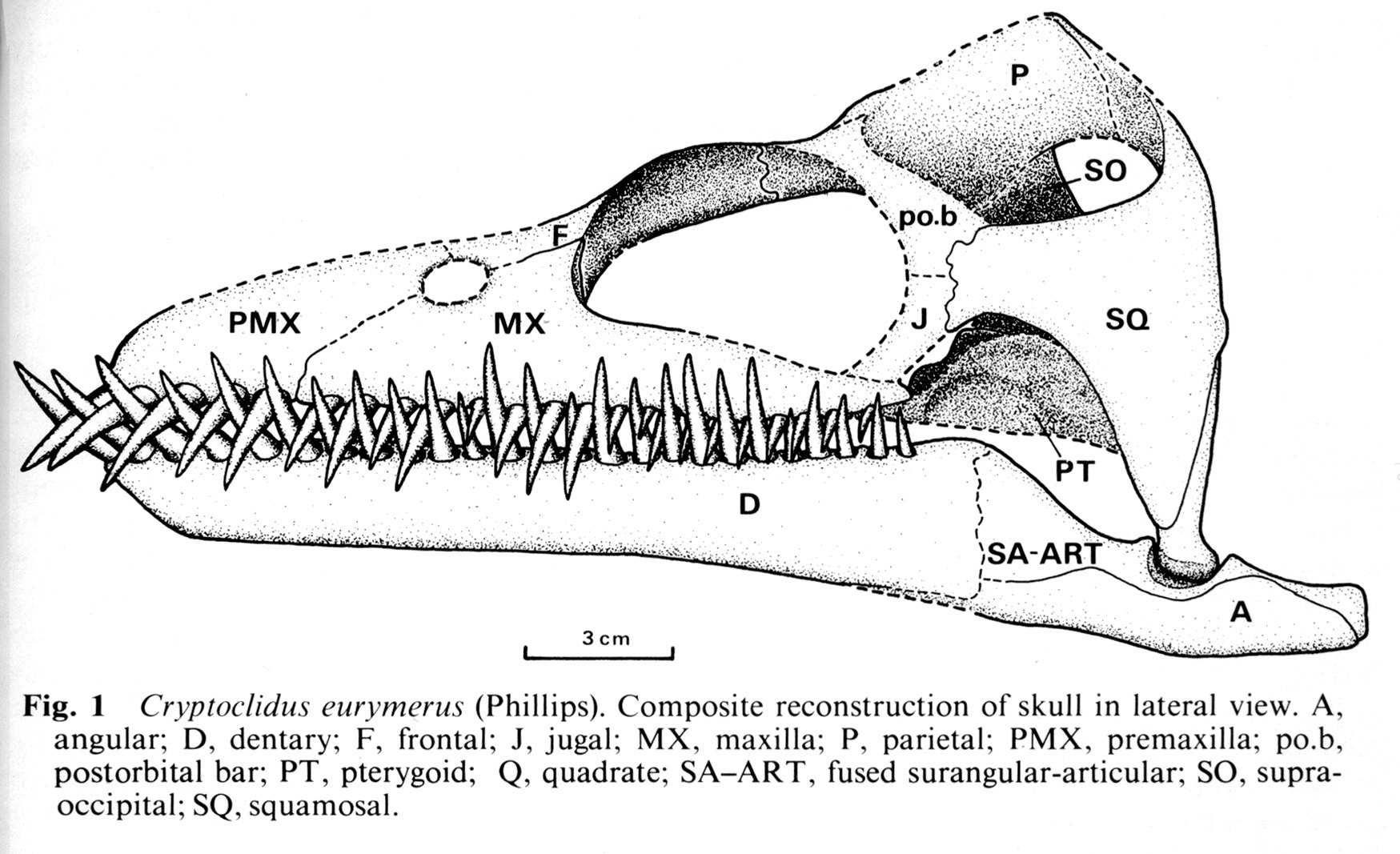
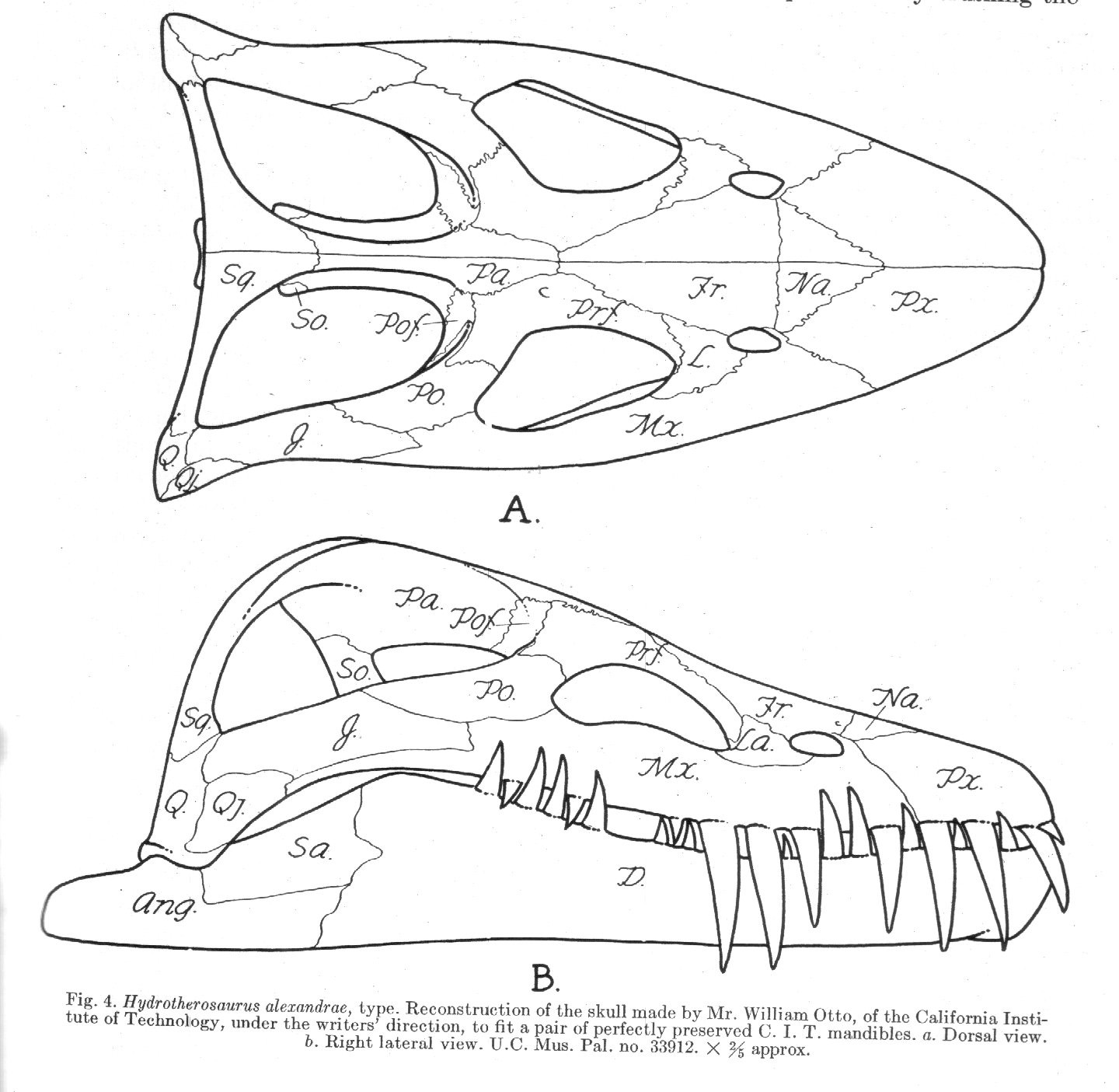

Now, even just looking at these skulls and giving them the eye test it is readily observable that there are some differences. The Hydrotherosaurus skull just looks more battle ready; longer, larger and more heterodont dentition; relatively larger temporal muscle site; a deeper lower mandible; stronger symphyseal union. If plesiosaurs were all supposedly "gape limited predators, a threat to nothing larger than a small fish or squid" why such divergence if they were all so limited in prey choice? The answer of course is that in my view they were not so limited in prey choice and carcass utilization as generally presumed. If we invoke a group foraging strategy then I think that definitely ups the ante in terms of what these guys might have been biting into... how big? Well let me put it to you this way: personally I would not feel comfortable with swimming with a Hydrotherosaurus or even a Cryptoclidus - alone or in a group. An eighteen inch head is still an eighteen inch head. And even in supposedly fish eating pinnipeds it has become increasingly apparent that they do engage in tackling quite large prey items. If a plesiosaur locked onto you and you yank away, you are leaving something behind.  I have kept too many diapsid pets that I know if they think that they can overpower you and get you in their belly, by hook or crook, that they are going to try and do so. Take that as you will.

To familiarize with what a much smaller, shorter, weaker toothed, and weaker jawed "small prey specialist" can do with its chompers check out these moray eel pics/videos.


Now the video above has been making the rounds for a bit now but it goes to show the impressive way a moray can utilize its body and jaws to subdue a small white tip reef shark. The video below is actually more interesting and startling actually - you might want to skip to about the 2:10 mark where a large green moray disturbs a lobster which seems to jump out of the water and never reappears (?!), and then the moray just charges the diver and does a small nip, but not really a dedicated bite per se. Did the moray see the human as possible predator? competitor? Startling video none the less.


Another scary video (below) about a diver who habituated a green moray (Gymnothorax tunebris) to feed off of little sausages. Unfortunately the eel mistook the divers thumb for a sausage and off went the thumb!! On the bright side at least the diver was not skinny dipping!!


For me there is little doubt that a 13 meter long, several ton plesiosaur - with a much heavier and stronger frame to spin off of - could do much more damage than 2 meter long moray eels. Just in case you are not convinced just look (graphic warning) at the bone scraping damage a green moray can incur on a humans arm. My point is not to shock with these clips but show that an animal with non-serrated, fish catching jaws can still do a good number on larger sized items.

And that's a-moray... eel skull. Looks vaguely plesiosaur like no?


Ok small digression there, just trying to chip away at the notion that all plesiosaurs did was bite into small stuff. Let's get back to deep diving plesiosaurs. And I think it worth mentioning that there are still loads of questions regarding how deep diving modern predators, especially air breathing tetrapods, work and operate at such depths. Never mind the fact that the sperm whale, an animal whole industries were founded upon, is still a huge mystery. Forgetting about the good old cachelot, let me point you in the direction of an interesting study of short-finned pilot whales (Globicephala macrorynchus) which contrasts their foraging ecology with that of the various species of beaked whales that they share deep sea habitat with off the Canary islands. Full paper here.
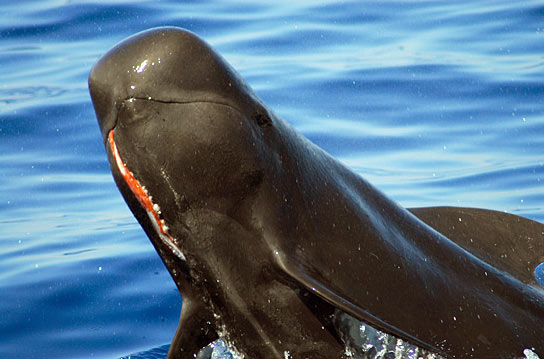
Short-finned Pilot Whale w/large squid tentacle. (c) Pablo Aspas
Their research on short-finned whales, which they dubbed "the cheetahs of the deep", points to an "all or nothing" foraging strategy of rapid and vigorous dives of 20 minutes or less in search of, evidently, fairly large cepahalopod prey including Architeuthis dux - the giant squid. These high energy and oxygen consuming dives are presumed to be the reason this species, when observed on the surface, are observed to be quite sedate and approachable - they are recovering from stressful and often unsuccessful deep sea pursuits of large cephalopods. Beaked whales, on the other hand, move and pursue prey at a more leisurely pace in their dives and generally, as the authors suggest, are "berry pickers" using suction to capture numerous smaller prey items through out the water column all the way to the sea-floor. This difference in foraging technique offers a suggestion of resource partitioning and also adds insight into why so little is known on beaked whales and why they are so rarely observed at the surface. Their more leisurely foraging technique, allows them to remain underwater longer and spend less time on the surface than short-finned pilot whales.

In comparing these two deep diving foraging strategies with regards to plesiosaurs I definitely would hedge more towards the "berry picking" of small prey and slow and leisurely foraging style of beaked whales than the "all or nothing" style of short-finned pilot whales. In plesiosarus the cryptic head at the end of a long neck allowed stealthy approach and lack of high velocity swimming/maneuvering capability further speak to beaked whales as a better analog than short-finned pilots - at least among the plesiosaurs that habitually dove into the mesopelagic/abyssal realms after prey. Of course I also think that such plesiosaurs, although having a predilection for small prey - would have opportunistically taken medium sized prey/scavenged carcasses as well. Let's look at a family of deep diving predators, that emphasizes cryptic, stealthy predation to the nth degree and which opportunistically catch prey from the abyssal realm all the way to shallow water - sharks of the genus Somniosus of the dogfish family - Squaliformes.

Video above really highlights the "blob of jelly" aspect of Sleeper sharks. Cook Inlet, Alaska.

Somnio: "a dream, sleepy". Sharks of the genus Somniosus, which may compete with the great white shark for title of largest extant predatory fish, are truly creatures out of a dream - or, more precisely, a nightmare. The Greenland shark (Somniosus microcephalus) holds the title of the world's slowest swimming fish (when corrected for size). Paradoxically there is evidence that this shark hunts and catches several species of seal as well as numerous fast, bony fish. It has increasingly become apparent that the slow cruising speed allows this shark to approach undetected towards sleeping or resting marine mammals and fish. The Greenland shark and other sharks of this genus occupy a unique niche of an exceptionally long lived - low metabolism, cryptic, slow cruising, opportunistic predator of a wide variety of prey types and sizes from throughout the water column. More detailed studies of the closely related Pacific sleeper shark (Somniosus pacificus) by the Alaskan Department of Fish and Game further support this adaptation. Investigating whether a marked increase in Pacific sleeper shark population was responsible for Stellar sea lion declines the researchers performed stomach analysis and PAT tagging work revealed a conspicuously wide ranging and catholic predator.

Pacific Sleeper Shark. wiki
Researcher Lee Hulbert found that far from being a deep water specialist the Pacific sleeper shark stayed below  the photic zone during the day and moved into shallower waters during the night when its dark color and silent approach with minimal hydrodynamic disturbance allowed it to approach prey including rockfish, pollock, salmon, flounder, halibut, cod, and marine mammal including harbor seal and whale - either predated or scavenged. The sharks moved in constant vertical oscillating patterns, averaging 6 km a day. Concerning their movements Lee said, "These sharks never stop moving. One of  them logged 12,000 vertical meters in 24 hours. The guys at Wildlife Computers had never seen anything like it from any animal."

All right so I think, in a necessarily piece meal fashion, many plesiosaurs that foraged in the open ocean would fit nicely somewhere between the "cherry picking" leisurely foraging of beaked whales and the slow, cryptic, vertically oscillating, and opportunistic foraging of sharks belonging to the genus Somniosus. Combined with the group foraging strategy outlined above, moving in a vertically orientated matter to further hide the body and diminish hydrodynamic disturbance, and the benefits of a long neck to cover a large feeding envelope and, for me, this is a pretty diabolically efficient foraging adaptation. As I mentioned at the beginning of this post plesiosaurs certainly were more diverse than usually portrayed and several specialized in shallow water/lagoonal settings (Crypotclydidae and Leptocleididae come to mind) and some potentially engaged in lots of benthic, demersal foraging similar to what the white tipped reef sharks were doing. But in all cases; deep water, shallow water, or sea bottom foraging or any combination there of - a cryptic approach combined with the benefits of group foraging and the unique physical proportions of plesiosaurs suggest a very successful foraging adaptation.

Anyways hope you stayed with me for the whole post. I know it was a little all over the place but with a difficult group of critters with no exact analogues it has to be a little chaotic and piece meal. Maybe you are not swayed with the idea of some plesiosaurs biting into bigger stuff than generally presumed or you think the whole group foraging hypothesis is a little too tenuous and speculative. And as many have noted the preserved stomach contents point towards small stuff. I want to explore this further in future posts but let me suggest that there can be fossil bias in stomach contents as well. If plesiosaurs are assiduously avoiding large bones due to obvious choking hazards and flesh does not fossilize (as well) we simply won't see evidence of larger animals in their diet. We now know from field observations that pinnipeds will kill good size cetaceans and sharks and strip high energy blubber and liver off of these respective animals. Yet the majority of their diet is small stuff. If these animals were fossilized there likely would be no evidence of these episodic moments. I will revisit these topics in future posts and hopefully can sway you.


Support me on Patreon.
Like antediluvian salad on facebook.
Watch me on Deviantart @NashD1.Subscribe to my youtube channel Duane Nash.


Monday, January 6, 2014

Where Kevin Love Becomes... an Ammonite?

I want to switch gears a bit, staying in the Mesozoic, but getting our feet wet a little talking about ammonite paleobiology. Ok so I have been stewing on how I should approach this post for a while now and finally it came to me: I can approach this topic through discussing sports. More specifically the basketball player Kevin Love, vampire squids, and ammonites. And I am 100% confident that in the future if you enter Kevin Love, vampire squid, and ammonites into a google query this post shall become the number one hit for any discussions on these three topics!!


Now for most, if not all, people the three subjects- Kevin Love, vampire squid, and ammonites- are not going to be typical water cooler talk. Well thankfully for you and I, I am not most people. So let's start off by talking about my favorite basketball player- Kevin Love. If you are a paleo nerd like myself but don't pay much heed to sports that's ok- I will give you the low down. For myself I have always noticed a continuum between paleontology-biomechanics-functional anatomy-sports science. For Kevin Love his bread and butter has and continues to be his dominance on the glass- rebounding. Now you might assume that height is the predominant attribute of a good rebounder and truth be told being tall does help in rebounding. But a quick perusal of past top NBA rebounders shows that exceptional height is NOT a prerequisite to exceptional rebounding among the elite. Dennis Rodman, arguably the greatest rebounder of all time is 6' 7" and Charles Barkley, the round-mound of rebound, is 6' 6". Kevin Love, although listed at 6'10", is actually closer to a 6' 8" because of lies, damnable lies. Although such heights are impressive to average people, in the NBA with multiple true 7 footers these are not exceptionally tall individuals.

Ok, so if exceptional height is not a prerequisite for exceptional rebounding maybe a guy like Kevin Love does it through jumping ability? Nope, although Love is famous for winning the "white guy award" he is actually an average jumper at his position and his game is more or less under the rim. So how does he pull down a league leading 13.5 rebounds per game?

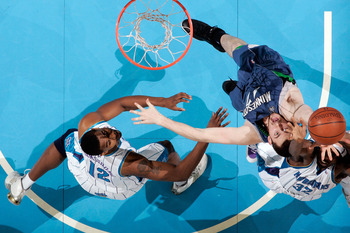
For Love it is all about anticipation, positioning, and leverage. Anticipate where the ball will bounce off the rim. Despite all the tall, athletic people in the NBA most missed shots are rebounded BELOW the rim and bounce to the side opposite from where they are shot. Knowing the tendency a ball will bounce allows a solid rebounder to anticipate, establish and maintain a zone where he, and only he, can have access to this zone. This is called "boxing out" and is done by using the butt, hips, back and arms to put the opposing rebounder in a detrimental position. At this point getting the rebound is less about being taller or a better jumper but simply carving out a zone of maximum probability of where the ball will bounce. And finally leverage- by keeping your competition on your back you can use the leverage of your own body against theirs to jump up and get the rebound. Despite going against taller and better jumpers Love is a master at this tactic and it allows him to neutralize other players height or athletic ability- as the pic above attests to. Watch the video below for Love versus a sumo wrestler on the box out for a more "sciencey" analysis.


Ok so maybe if you have no interest in sports and you now have a better appreciation for basketball fundamentals- so what does rebounding have to do with vampire squids and ammonites? Well I need you to make a little mental jump with me here. For my purposes here you want to substitute the idea of a rebound, a basketball falling from a high area to a lower area, with biomass falling from a high area to a low area. What is the largest and most continuous biological "rebound" occurring on the earth today?  If you guessed it occurs in the ocean you guessed correctly and if you answered the continuous fallout of marine snow across all of the oceans from the photic zone (plants grow) to the aphotic zone (no plants grow) you are right again. One of the more interesting things we are learning about marine snow is that on its way down it is probably ingested and egested several times. This does a couple things; small bits of dead plankton, bacteria, microscopic detritus are made to clump together after being eating. This clumping allows the snow to achieve the mass to actually fall downwards as opposed to remaining neutrally buoyant in the water column. It is only after all the small micro bits have clumped together that they take on the characteristic marine snow behavior serving as a food source for deeper dwelling organisms. Now just as Kevin Love makes a living off of rebounding the basketball, numerous organisms - part of the "deep scattering layer"- make a living off of this motley assortment of dead animals, plants, bacteria, silt, and fecal bits which predictably fall from shallow to deeper waters. And just as Kevin Love must anticipate and establish where to be to collect his rebound- so too must the denizens of the deep scattering layer anticipate and establish themselves in the right spot to collect their biological rebound of deep snow. Numerous organisms take advantage of marine snow as a food, the snow that reaches the sea floor serves as food for various echinoderms, especially brittle stars and sea cucumbers, and other benthic critters.
MBARI(C) Sea Cucumbers eating dead alga

An interesting facet of marine snow ecology is that the daily trickle down economics of marine snow was not making much sense in terms of the amount of life seemingly dependent upon it. What researchers are finding out however is that large pulses of biological activity- an algal bloom, salp bloom - create corresponding intense marine snow storms. And it is these intermittent pulses of extreme biological activity, sometimes years apart, that are necessary for the critters in the deep to persist in such numbers.

So not only do critters that live off of marine snow have to be in the right spot to corral it- they have to be  there at the right time to take advantage of occasional pulses of intense marine snow storms. Check out the video below here to see what a marine snow storm looks like.


Now one of the more interesting stories to emerge from the deep in the last couple of years was the revelation that the sinister looking vampire squid, Vampyroteuthis infernalis, subsists on marine snow. This strange looking cephalopod is actually very close to the divergence of octopi and squid and is the only cephalopod known to subsist on detrital resources. Please watch the video below from the Monterey Bay Aquarium Research Institute.


The vampire squid reels out a long mucousal string that passively catches marine snow and it reels it in. It lives in the oxygen minimum zone and thus has little predation pressure and no investment in quick locomotory organs. In short, it carved out a great niche as a rebounder of marine snow.

And now for the ammonites. What has long perplexed me is that for many types, including the largest ones, they don't look particularly streamlined or adapted to an active pelagic existence. Feel free to correct me in the comments below but if I wanted to be an active pelagic carnivore or even planktivore, in oceans full of mosasaurs and other beasties I would want a streamlined shell not a round cumbersome shell typical of the largest ammonites.

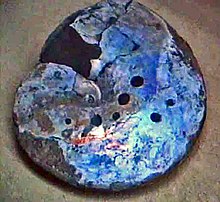
Ammonites, like modern cephalopods, doubtless exhibited a wide variety of ecologies- from active pelagic predators to benthic hunters and we do know of at least one type of straight shelled ammonite, Baculites, that likely dined on plankton. So let me just throw the idea out there, what if some types of ammonites - especially those large massive types - exploited marine snow a la the vampire squid? There is no reason to suggest marine snow was not a potential resource in Mesozoic oceans. If these putative detritivorous ammonites pursued such an existence they likely cast out a much larger mucousal net to gather snow over a much larger area than vampire squid. Unlike the vampire squid which casts a little string out maybe something similar to the mucousal nets produced by pelagic tunicates was utilized?
chain of salps. wiki

Seen as deep sea inhabitants possibly of the deep scattering layer the large septum of ammonites would allow them to change their relative buoyancy and adjust their position in the water column. Remember what I said earlier about being in the right position for that rebound?

If we look at the Mesozoic oceans they are often characterized by less mixing of the ocean layers than modern oceans and, if I can paint with a broad stroke, often times a ubiquitous anoxic zone in which no air breathing life - including ammonites - could survive. So essentially once marine snow sank beneath a certain depth it was out of the game - a carbon sink. In an ocean with an anoxic bottom layer the bottom is essentially pushed up for all intents and purposes as far as life goes. If certain ammonites were consumers of marine snow, maybe they were the last line of defence for snatching that last bit of organic matter before it sank out of the system? And if so, such a recoup of organic material doubtless played a not too subtle role in the Mesozoic ocean carbon balance.  And while ammonites with their buoyancy control and putative ability to pump water over their gills like modern cephalopods may have been dominant ecological players down there and largely safe from sharks/predatory fish- that does not mean deep diving air breathing predators did not exploit them. So there may have been an evolutionary advantage to be big, with a thick shell to survive predatory attacks from mosasaurs/pliosaurs etc etc.


The mother Hainosaurus is a 13 meter bruiser of the open ocean. For several years now she has raised successive clutches of young off some deep sea atolls in the eastern Atlantic. Here the 2 meter youngsters, she has a half dozen in tow with her now, face less predators than in near shore waters. Not that much would mess with mother anyways, except maybe another Hainosaurus. The subtropical waters near the surface are largely devoid of life, but the mother knows were to find some shelled calamari a la carte. Experience has taught her that deep below at about 300 meters large ammonites, some over 3 meters in diameter, abound. Occasional convergences of deep ocean currents against the atoll and river runoff from several large oceanic island continents to the east- what will eventually become Europe -provide spectacular but short lived plankton blooms which eventually filter down into the depths to feed the great cephalopod titans of the deep. These shelled beasts are no easy prey. They form massive colonies with interlacing networks of mucousal nets, some nets spanning the length of a basketball court- nets which serve to not only ensnare their diet of deep sea copepods and marine snow- but work as an early detection system for approaching predators. But once the ammonites make a move towards deeper water, they themselves betray their presence to the mosasaur by their disturbance of bioluminescent organisms. But even if a mosasaur latches onto a large ammonite the deal is not done. For the mosasaur the impetus is to get this meal back to the surface as soon as possible- no time to kill and eat down here, just let the pressure change do the killing. For the ammonite the strategy is to keep the struggle in the deep for as long as possible. With an ability to rapidly control buoyancy, entangle predators in mucous and tentacles, sturdy shell, and jet propulsion only the largest and most experienced Hainosaurus actually tackle the mega-ammonites. For mosasaurs that are too small, get too cold, run out of oxygen or try to take on ammonites too large the penalty may be death.


After descending for several minutes the mother Hainosaur becomes neutrally buoyant and finally negatively buoyant, where she starts to sink like a stone. After several more minutes she is over 250 meters deep and begins a more horizontal search to look for ammonites. In these depths she is not looking for the ammonites themselves, but the faint bioluminescent glow of their mucousal nets. It does not take her long to find a colony of several hundred ammonites ranging in size from a couple of centimeters across to almost 3 meters across. To feed her and her clutch she wants one of the big boys though. Even after she finds the colony she does not plunge right into them but waits for one of the ammonites to startle, ditch its net and dive deep. After coursing the colony several times a few ammonites bolt for deep water but it is only after she sees the bioluminescent wake of a particularly large ammonite does she make her attack. The bite is not a kill bite however, she simply wants a firm grip. Even with her massive jaw and gouging teeth these shelled behemoths take too much time and energy to kill and eat at these depths. 


Now comes the hard part. From experience the mother knows the tough part is bringing her prey back to the surface. Not only must she fight past the negative buoyancy of her own weight but also the ammonite is doing everything in its power to keep the fight in the deep for as long as possible. And these cephalopods of the deep are witty. First they attempt to smother the mosasaur with their mucous net and if that fails tangle them up with their tentacles. But the mother has seen these moves dozens of times before. In earlier years she panicked and had to abort attacks. But now she knows that the real battle is just getting back up. But the cephalopod tries to thwart the upward movement as well. First by pumping water through its siphon to stay down and then by active pumping of water and gas through its various septums to be as heavy as possible. But again the mother has countered these moves because she has conserved her oxygen and energy for the fight to the surface. By the time the mother is at 50 meters the ammonite is largely devoid of fight from the changes in pressure. Feeling the vibrations from the fight below the clutch of baby Hainosaurs have met the mother at this depth and begin attacking the ammonite, twisting off tentacles like crocs doing death rolls. The mother lets her clutch do the killing and only after she recoups her energy does she start smashing the shell apart at the surface. She makes a note of the electromagnetic signature of this locale for further sounds.


Well like I promised Kevin Love, vampire squid, and ammonites!!!

Cheers!!


Support me on Patreon.
Like antediluvian salad on facebook.
Watch me on Deviantart @NashD1.Subscribe to my youtube channel Duane Nash.


Related Posts Plugin for WordPress, Blogger...