Showing posts with label Yemen. Show all posts

Friday, July 27, 2012

The Desert Cloud Forests of Yemen and Oman

As I hinted to in my last post I had recently learned of a very unique forest ecosystem in, of all places, the Arabian countries of Yemen and Oman. Located on the southeast of the Arabian peninsula Yemen and Oman are dominated by dry desert conditions except for 1% of the land- and it is that 1% we will be looking at called the desert cloud forest.

© Sebastian Kennerknecht

What makes this habitat possible is a unique interplay of ocean, elevation and desert. While other cloud forests receive water from both rainfall and capturing moisture from clouds- they generally receive enough water from rainfall alone that even without the moisture from clouds they still would exist as forest of some type. However in desert cloud forests it is the added moisture from the clouds that really allows the habitat to cross the threshold from desert scrubland/grassland to true forest. The desert cloud forests of the Hawf and Dhofar regions of Yemen and Oman respectively achieve this remarkable feet in several ways. First of all, like all cloud forests, these desert cloud forests occur relatively close to the ocean at no more than 15 km from the Indian Ocean. Secondly the cloud forest occur on an escarpment about 300-700 meters above sea level. Past the escarpment is dry plateau morphing into desert.
After the meager rainy season ends the inland desert heats up. However in the zone of the cloud forest this is the time of maximum cloud coverage. During this season the vegetation literally "intercepts" moisture from the air which trickles down into the ground- ultimately adding more water to the environment than rainfall does. In addition, during this critical period of about 3 months transpiration rates are low because solar radiation is deflected by the cloud cover. After the cloud cover breaks the forest is poised to green up aggressively due to the bank of water the system has accumulated from the rainy season and the cloudy season. Eventually transpiration outstrips the capacity of the forest and the trees go through a deciduous dry season dormancy until the rains return.

   Dhofari Buttontree.  Anogeissus dhofarica
The most important member of this community is the Dhofari buttontree, Anogeissus dhofarica, which is the dominant canopy tree and also intercepts the majority of the water from passing clouds. Unfortunately the tree is a favorite browse of the camels which are brought into the forests by local Bedouins. Camels, in the local society, are much like cadillac escalades in American society- a sign of wealth above and beyond what is really necessary- and the more camels an owner can keep in his herd the more prestige he has.

© Sebastian Kennerknecht
Unfortunately camels in such numbers may ultimately over-browse the system to such an extent that the trees which intercept water from the clouds lose their capacity to do so. In this scenario the trees would give way to desert grassland.

© Sebastian Kennerknecht


Regular readers of da' salad should recognize that islands and the effects of large herbivores on an islands flora is a repeating riff here. What we have here in the desert cloud forest are various herbivores- camels, goats, cattle- brought into an isolated environment that is very vulnerable to minor perturbations.  When we look at the desert cloud forests of Yemen/Oman it can be seen that we are in fact dealing with "islands" of a different sort...


As seen in the above satellite photos the desert cloud forests (dark patches towards right) are literally small little islands in a sea of desert. This is an important concept to grasp. If this ecosystem disappears,  and it is the last remnant of a formerly more widespread forest habitat of the middle east, there is literally no where for it to go to.

An island need not be surrounded by water.

© Sebastian Kennerknecht


Pertinencia

Many of the photos in this blog were graciously provided by Sebastian "Seabass" Kennerchnect
 he has a great blog you should check out at http://blog.pumapix.com/
http://blog.pumapix.com/2012/03/24/conservation-struggles-in-yemen/
http://blog.pumapix.com/2012/04/01/camera-trapping-in-yemen/

(Miller and Morris 1988) Desert Cloud Forest: Adapting a Unique Ecosystem to Climate Change
http://www.profor.info/profor/sites/profor.info/files/docs/CloudForests_Adapting_Climat_Change.pdf


Support me on Patreon.
Like antediluvian salad on facebook.
Watch me on Deviantart @NashD1.Subscribe to my youtube channel Duane Nash.


Thursday, July 26, 2012

Socotra: The Strangest, Most Enchanting Island You Never Heard of


We here up in da' Salad like things of a slightly weirder bent so when my physical therapist mentioned a forest in Yemen I had to investigate further. Turns out there is a forest in Yemen (more to come on that later) but in my Internet sleuthing I kept on coming across references to an island off of Yemen called Socotra. Further research revealed this island to be a very special place indeed.


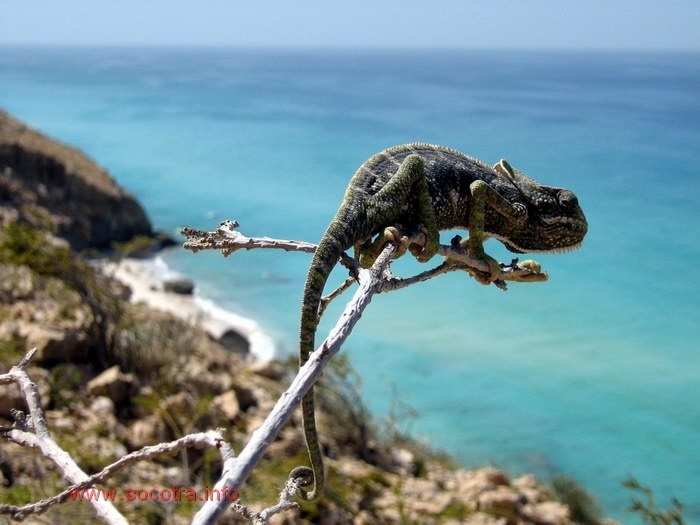
Six million years of isolation mean that this archipelago is third behind the Galapagos and Hawaii in terms of endemic species and it is the most isolated piece of continentally derived land on the planet. While there are number of unique reptiles, birds, snails, and even a terrestrial crab which is the top predator of the island- the island is most notable for its unique flora such as the Dragon's Blood Tree pictured at the start of the post (the sap is red like blood). But other plants are no less evocative looking and are why the island is often referred to as the most alien place on earth.

Desert Rose. Adenium obesum
Greek historical texts allude to a strange bestiary that accompanied the unique flora until relatively recently. This anecdotal evidence mentions giant snakes, lizards, and crocodiles inhabiting the isles as well as three species of giant land tortoise. One text mentions the fat of one of the giant lizards was often used as a good substitute for olive oil. Although we lack direct fossil evidence for this "land of dragons" perhaps exploration of the islands extensive karst topography will reveal bones of these mega-reptiles hidden in some deep caverns.

Copywrite The Mysterious Socotra Island. http://www.funonthenet.in/articles/Socotra-Island.html

 Of course just looking at the dry subtropical landscape and one can not help but imagine giant reptiles swarming around on it. How these reptiles lived one can not help but imagine. Were the lizards herbivorous, like giant skinks maybe? or possibly monitor lizards? Or perhaps the lizards and crocodiles were not herbivorous at all but feasted on the abundant crabs/snails/inverts of the islands?

The islands human inhabitants have their own ancient unwritten language and are derived from Arabian and African peoples. They have a long history of herding on the island but have adapted to the island in such a way that traditional herding practices do not greatly diminish the islands unique flora. However the loss of traditional pastoral practices, such as culling male goats, jeopardizes native flora.

Recognized by UNESCO as a world heritage site, the island just recently opened up for tourism.
One wonders if the island, so isolated and pristine, which has been colonized by many who ultimately leave- may have met its match in ecotourism.


Pertinencia

(Damme, Banfield) 2011. Biodiversity Conservation in the Arabian Peninsula Zoology in the Middle East. Past and present human impacts on the biodiversity of Socotra Island
www.kasparek-verlag.de/.../031-088%20VanDammeBanfield.pdf


Support me on Patreon.
Like antediluvian salad on facebook.
Watch me on Deviantart @NashD1.Subscribe to my youtube channel Duane Nash.


Related Posts Plugin for WordPress, Blogger...