
I wanted to make a Thanksgiving themed post today but I wanted to make it a little different. Instead of the usual "don't forget turkeys have some bad ass relatives" digression I wanted to make the argument that turkeys themselves are bad ass and they might teach us directly about some aspects of Mesozoic theropod behavior and appearance. Namely that male turkeys - in addition to their elaborate plumage & courtship displays - also regularly engage in combative behavior, including face biting behavior (insert discussion on abundant evidence for face-biting in Mesozoic theropods).

Pretty astounding behavior check out the full video here. Such behavior is not limited to wild turkeys as domesticated male turkeys will take on all kinds of foes including roosters as shown in this youtube video below. Now right here one can insert a whole discussion on cock fights, the long history of breeding fighter birds by humans, and the ethical issues raised. But for our purposes it should be noted that such behaviors are not without parallel in the wild fore bearers of these birds.
Or this particularly violent and prolonged battle between a Muscovy duck and some variety of fighting rooster (Asil?). As you can see in the comments someone mentions that this is how dinosaurs fought and I would have to concur.
Now I want to hit you with what this post is really all about. I will do this by pointing out - what is essentially staring at you literally right in the face - is that whether or not we are talking about tom turkeys, fighting cocks, or combative Muscovy ducks is that they all share one feature in common: abundant and garrulous, usually red, facial caruncles and a mainly naked head & neck.
 |
| credit The Photographer. Cairina moschata momelanotus. Margarita Island, Venezuela CC |
 |
| credit Charles Toth youtube clip |
To embellish my point let's not forget to mention both old & new world vultures which are often bald headed and heavily caruncled. Except for these birds such features may offer more utility in fights over territory and food as opposed to sexo-social battles as in the other birds mentioned.
 |
| Red-headed vulture. credit Shepherd, Dayton OH CC |
 |
| Andean Condor. credit Flickr Art G. CC |
 |
| lappet-faced vulture. wiki-commons |
Long time readers of this blog should not be surprised that I have been heralding both new and old world vultures as the best modern analogue to generalized, serrated toothed Mesozoic carnivorous theropods for quite some time now. People just need to get over the "scavenging" stigma for these animals - they offer more utility than sharks or monitor lizards in terms of how Mesozoic theropods behaved, moved across, and partitioned the landscape. Not only do sharks and monitor lizards fall down compared to theropods in terms of just about every meaningful gross anatomical/metabolic characteristic but the trait that is usually put forth as the unifying character linking these groups - serrated teeth - as I argued here both old & new world vultures (and giant petrels) have likely evolved an equivalent method of cutting and shredding carcasses: choanal grinding. Furthermore giant petrels, and both new & old world vultures are, you know, actually living derived theropods so there's that but it always seems to be that parsimony goes out the window with these things because TEETH. Get over teeth - modern day derived, soaring theropods are consuming more flesh on the African plains than all those "toothed" mammalian carnivores combined.
So when I stumble upon a youtube video (full video) showing essentially gang-turf warfare between two familial groups of black vultures (Coragyps atratus) and it has got "only" 711 views I got to raise a little ruckus. Not only are black vultures highly opportunistic and bold in their foraging - taking everything from turtle eggs to newborn calves - they also have evolved a kin-based group foraging method, are fairly terrestrial, and - as suggested by the author of this video - engage in territorial combat. Long story short this is the closest we are going to get to watching Mesozoic theropods engaged in combative face biting behavior. So I find it a little ironic that this window into the past is blatantly overlooked by a society supposedly obsessed with dinosaurs, especially face biting tyrannosaurids. Check out towards the end (about 20 second mark) where a chuck of one of the vulture's face gets ripped off and another vulture quickly gobbles it up.

"Now wait a second I thought group foraging was fairly rare in predatory birds and only Harris's Hawk regularly hunted in any sort of group hunting method?"
 |
| Black Vulture wiki commons |
This trend of foot first predation with the head essentially not interacting with the prey until after it is killed or incapacitated is in stark contrast to generalized predatory theropods which all - even dromaeosaurids - maintained good sized jaws and serrated teeth. Dromaeosaurids never became >as specialized< in foot dominated predation as eagles, hawks and other raptorial birds of prey. The head remained a useful and probably necessary tool in prey acquisition and dismemberment, not to mention combat both intra & extraspecific.
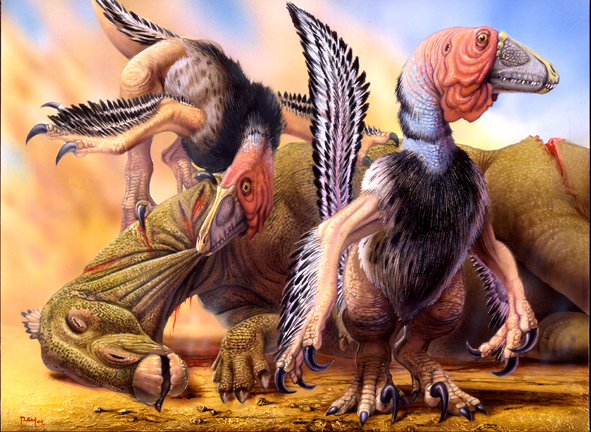 |
| credit Luis Rey. Maybe he was right all along? Link Deinonychus saga |
 |
| Dakotaraptor Emly Willougby CC4.0 |
Ask yourself, what do we really have in terms of full body feather preservation for medium-largish generalized dromaeosaurids? Not much really. Microraptor hardly counts as it is small, fairly specialized, and lives in a cool environment anyways. So I say better to look towards the birds that actually do combative stuff with their heads as opposed to hawks and eagles which don't really engage their head in battle much at all...

Gobble, Gobble.

"A Long habit of not thinking a thing wrong, gives it a superficial appearance of being right, and raises at first a formidable outcry in defense of custom". Thomas Paine
Support me on Patreon.
Like antediluvian salad on facebook. Visit my other blog southlandbeaver.blogspot
Watch me on Deviantart @NashD1. Subscribe to my youtube channel Duane Nash.

